
Table of Contents
ToggleAuthor: SmileBottles Editorial Team
Estimated Reading Time: About 15 Minute
If you’ve ever picked up a modern fragrance bottle and pressed the little button on top, you’ve already used a perfume atomizer. It’s one of those small parts of daily life that most people never really think about, yet it plays a huge role in how a fragrance feels, performs, and even how a brand is perceived on the shelf.
Whether you’re a fragrance brand looking for the right packaging, a wholesaler sourcing bottles for your clients, or simply someone curious about how your favorite perfume actually sprays out that soft, even mist, this guide will walk you through everything you need to know. You’ll learn what an atomizer is, how it works, the different types available, and what to look for when you’re ready to buy.
What Is a Perfume Atomizer?
A Simple Definition
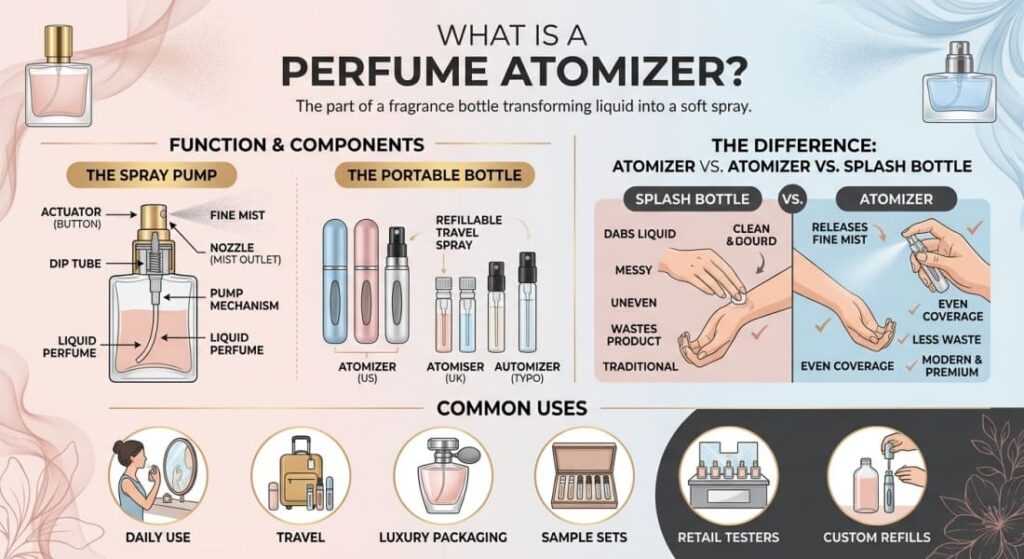
If you’re wondering what is a perfume atomizer, here’s the easiest way to think about it. It’s the part of a fragrance bottle that transforms liquid perfume into a soft spray. The word can refer to two things: the spray pump itself, or the entire small bottle you carry around for daily or travel use.
People often ask questions like what is an atomizer, what is atomiser, or even what is a atomiser, and they all point to the same thing. Some spell it differently depending on where they live. In the UK, “atomiser” is common. In the US, “atomizer” is standard.So the answer is simple: they’re the tools that let you spray perfume in a fine, controlled mist instead of pouring it on.
What Makes an Atomizer Different from a Regular Perfume Bottle
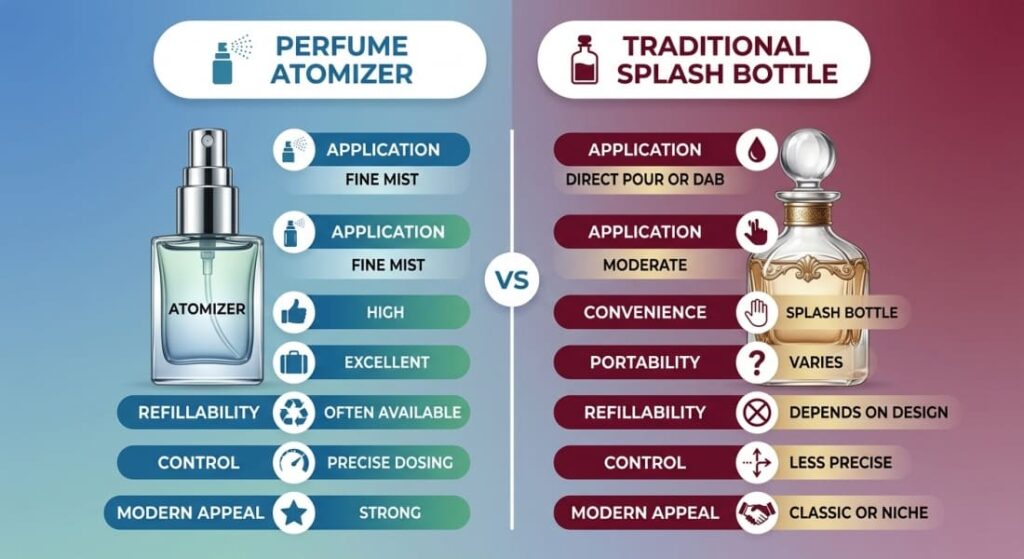
A traditional splash bottle asks you to dab fragrance onto your skin with your finger. It works, but it’s messy, hard to control, and often wastes product. An atomizer for perfume, on the other hand, gives you a clean, measured spray every time.
Here’s the practical difference:
Splash bottles pour liquid directly.
Atomizers release a fine mist.
Atomizers cover more skin evenly.
Atomizers waste less fragrance.
Atomizers feel more modern and premium.
That’s why most perfume brands today choose perfume bottle with atomizer designs. Consumers expect it, and it simply performs better.
Common Uses of Perfume Atomizers
You’ll find atomizers used in more places than you might expect:
Daily personal fragrance
Travel bottles for weekend trips or flights
Luxury fragrance packaging
Sample and promotional sets
Retail testers in stores
Custom refill bottles for niche perfume brands
For businesses, understanding these uses helps you pick the right style for your product line.
How Does a Perfume Atomizer Work?
This is one of the most searched questions online — how does an atomizer work. So let’s break it down properly.
The Basic Working Principle
When you press the top of an atomizer, a few things happen in a fraction of a second:
Your finger creates pressure on the pump.
That pressure pulls perfume upward through a small tube inside the bottle (called a dip tube).
The liquid travels through the pump chamber.
It gets pushed out through the nozzle at high speed.
The nozzle breaks it into tiny droplets — the fine mist you see.
That’s the science behind how do atomizers work. It’s a small mechanical process, but the quality of each part changes everything about the final spray.
The Main Parts of a Perfume Atomizer
If you’re sourcing bottles or trying to understand what makes a good one, it helps to know the components:
Actuator (spray button): the part you press
Pump mechanism: creates the pressure
Collar or crimp: holds the pump to the bottle
Dip tube: pulls liquid up from the bottom
Nozzle: shapes the mist
Bottle or container: holds the perfume
Cap: protects the pump and keeps it clean
A pressurized atomizer relies on all these parts working together. If even one is low quality, the spray suffers — you’ll get uneven mist, leaking, or clogged nozzles.
What Does an Atomizer Do, Really?
If someone asks what does an atomizer do, the honest answer is this: it controls how your perfume performs. A good atomizer means:
Even coverage on the skin
No sticky drips
Better scent longevity
A more premium feel when the user picks up the bottle
That last part matters more than people realize. A cheap-feeling pump can make even an expensive fragrance feel less luxurious.
What Does “Atomizer” Short Mean?
Some people search for what does atomizer short mean, usually because they see the word abbreviated on packaging or product listings. In most cases, it simply refers to a shortened or compact version of a standard atomizer — often a mini perfume atomizer or a portable perfume atomizer designed for travel and pocket-sized carrying.
Different Types of Perfume Atomizers
Not every atomizer is the same. Depending on your needs, one style will suit you better than another. Here are the main types you’ll come across.
Refillable Perfume Atomizers
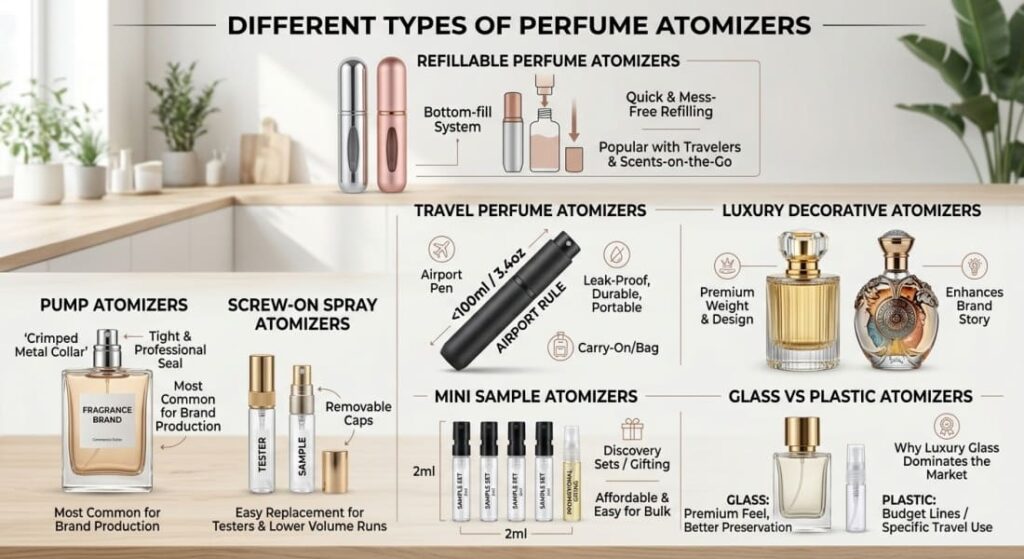
A refillable perfume atomizer is exactly what it sounds like — a bottle you can fill again and again from a larger perfume. These are popular with travelers and people who like carrying multiple scents without hauling full-size bottles around. The best refillable perfume atomizer designs use bottom-fill or twist-open systems that make refilling quick and mess-free.
Crimp Pump Atomizers
These use a metal collar that’s crimped tightly onto the bottle neck. They’re the most common style in commercial fragrance production because they seal well and look clean and professional. If you’re a fragrance brand, this is probably what you’ll want.
Screw-On Spray Atomizers
Instead of being crimped, these twist on and off. They’re easier to replace and often used for testers, samples, or lower-volume production runs.
Travel Perfume Atomizers
A good travel perfume atomizer needs to be leak-proof, compact, and durable. Airport rules also mean it needs to be small — usually under 100ml. Many people also look for a portable perfume atomizer they can slip into a bag or pocket without worrying about spills.
Luxury Decorative Atomizers
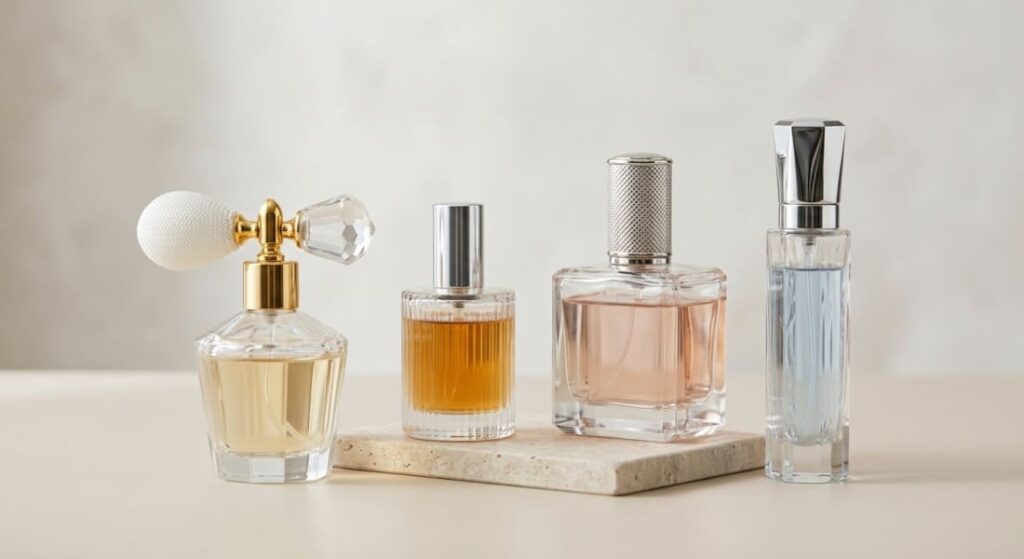
For high-end brands, a luxury perfume atomizer is often paired with heavy glass, gold or silver collars, and unique cap shapes. These aren’t just functional — they’re part of the brand story.
Mini Sample Atomizers
A mini perfume atomizer is perfect for discovery sets, promotional gifts, or letting customers try a fragrance before buying the full size. They’re small, affordable, and easy to produce in bulk.
Glass vs Plastic Atomizers
A glass perfume atomizer almost always wins for premium positioning. Glass feels heavier, looks better, and preserves fragrance longer. Plastic has its place for budget lines or specific travel products, but for luxury and mid-tier brands, glass is the standard. That’s why luxury glass perfume bottles dominate the high-end market.
Key Benefits of Using a Perfume Atomizer
You might already have a sense of why atomizers are so popular, but here’s a clearer breakdown of the benefits.
Fine and Even Mist Application
The whole point of a fragrance atomizer is to spread fragrance evenly. A fine mist covers more skin, which helps the scent develop naturally on your body chemistry.
Better Convenience
One-hand operation, easy to carry, no mess. You can spray in seconds without opening a cap and dipping your finger in.
Improved Fragrance Control
You know exactly how much you’re using. That’s important for strong fragrances where a little goes a long way.
Less Waste, Less Leakage
Well-made atomizers seal properly, so you’re not losing perfume through evaporation or spills. Over a year, that adds up.
Stronger Brand Presentation
For brands, this matters a lot. An atomizer perfume bottle feels more premium than a splash bottle. It supports higher price points, better shelf appeal, and better unboxing experiences.
How to Use a Perfume Atomizer Properly
Using one is easy, but there are still small things you can do to get better results.
Step-by-Step
Remove the cap.
Hold the bottle upright, about 5 to 7 inches from your skin.
Aim at pulse points.
Press the spray head firmly.
Let the fragrance dry naturally.
Replace the cap to keep the nozzle clean.
Best Places to Spray
Pulse points work best because they give off body heat, which helps the scent open up: Wrists, Neck, Behind the ears, Inner elbows, Chest
Small Tips That Make a Difference
Don’t rub your wrists together after spraying. It breaks down the fragrance.
Store your perfume away from sunlight and heat.
Keep the nozzle clean to avoid clogging.
Don’t spray too close to your skin — you’ll get a wet spot instead of a mist.
How to Open and Refill a Perfume Atomizer
A lot of people ask how to open a perfume atomizer, especially when they’ve bought a refillable one for the first time. It depends on the design.
Check Compatibility First
Not every atomizer is refillable. Some are sealed at the factory. Before you try anything, check:
Is the top removable, or is it crimped shut?
Does it have a bottom-fill valve?
Is there a twist-open base?
Step-by-Step Refill Guide
For most perfume spray atomizer designs made for refilling:
Remove the outer cap.
Pull off the spray head (for pull-off types) or unscrew the base (for twist types).
Use a small funnel or a bottom-fill pump to transfer the fragrance.
Don’t overfill — leave some air space at the top.
Reattach the spray head or close the base firmly.
Test with a quick spray into the air.
Common Mistakes to Avoid
Overfilling causes leaks.
Mixing two fragrances by accident ruins both.
Forcing a pump the wrong way can bend the dip tube.
Refilling without cleaning first mixes old residue into new perfume.
How to Clean a Refillable Atomizer
Empty out the remaining liquid, rinse with a bit of warm water or alcohol if the design allows, and let it dry fully before adding new perfume. This keeps your fragrance clean and prevents contamination.
Perfume Atomizer vs. Traditional Perfume Bottles
Here’s a quick side-by-side comparison to help you see the difference clearly. For most modern brands and consumers, the atomizer wins on nearly every count. That said, traditional bottles still have a place in niche perfumery where the ritual of applying fragrance by hand is part of the experience.
How to Choose the Right Perfume Atomizer
If you’re buying for personal use, the choice is simpler. If you’re sourcing for a brand or business, there’s more to think about.
Consider the Material
Glass is durable, recyclable, and premium-looking. It also doesn’t react with fragrance oils, which helps preserve the scent. That’s why custom glass perfume bottles are the standard choice for serious fragrance brands.
Check Spray Performance
A good spray should be:
Fine and even
Consistent from the first press to the last
Free of drips or heavy droplets
Leak-proof around the pump
Think About Refillability
If you want your customers to reuse the bottle, or if you’re selling travel-size versions, refillability matters. Bottom-fill atomizers are the easiest option for consumers.
Match It to Your Brand
Different atomizers fit different brand images:
Minimalist brands often use clean, clear glass with simple caps.
Luxury brands use heavy glass, metallic collars, and custom cap shapes.
Travel-focused brands use compact, leak-proof designs.
Gift-focused brands often go with decorative or unique bottle shapes.
Look for Customization
If you’re working with a perfume packaging manufacturer, ask what customization options are available. Good suppliers usually offer:
Custom bottle shapes and sizes
Various collar finishes (silver, gold, matte, colored)
Different cap designs
Custom printing, coating, or metallization
Matching accessories
Where to Buy Perfume Atomizers and What to Look For
Where you buy depends on what you need.
For Personal Use
Retail stores, beauty shops, and online marketplaces have plenty of ready-made options. Just check reviews for leakage and spray quality before buying.
For Businesses and Wholesale
If you’re sourcing at scale, working directly with a perfume bottle manufacturer is the smart move. You’ll get better pricing, more customization, and stronger quality control. Look for a glass perfume bottle manufacturer with a strong track record in export, quality testing, and design flexibility.
Options like custom perfume bottles wholesale give you control over branding, sizing, and packaging — which is essential if you’re building a fragrance line that needs to stand out.
What to Check Before You Buy
Before committing to a supplier, look at:
Material quality (especially the glass and the pump)
Spray performance testing
Sealing and leak resistance
Design and customization options
Compatibility with your fragrance formulation
Lead times and MOQ
Packaging protection during shipping
Questions to Ask a Supplier
A few good ones to start with:
Can you customize the bottle shape and collar?
What sizes are available?
Do you offer matching atomizers and caps?
Can I get a sample before ordering?
What testing do you run for leaks and spray consistency?
What’s your typical production time?
A serious perfume packaging supplier or perfume atomizer manufacturer will answer these clearly and offer samples without hesitation.
Common Perfume Atomizer Problems and How to Fix Them
Even good atomizers can run into issues. Here’s how to handle them.
Why Is My Atomizer Not Spraying?
Usually it’s one of these:
The nozzle is clogged with dried fragrance
The bottle is nearly empty
The pump is damaged
There’s air trapped inside
Try priming the pump with a few firm presses, or gently clean the nozzle with warm water.
Why Is It Leaking?
Leaks usually come from:
A loose or damaged seal
An overfilled bottle
A cracked collar or pump
Poor manufacturing quality
If it’s a quality issue, contact the supplier. If it’s user error, refill more carefully next time.
Why Is the Spray Uneven?
This often happens when:
Air is stuck in the pump chamber
The nozzle has residue on it
The fragrance is too thick for the pump
A few test sprays into the air usually solves it. If not, the pump itself may need replacing.
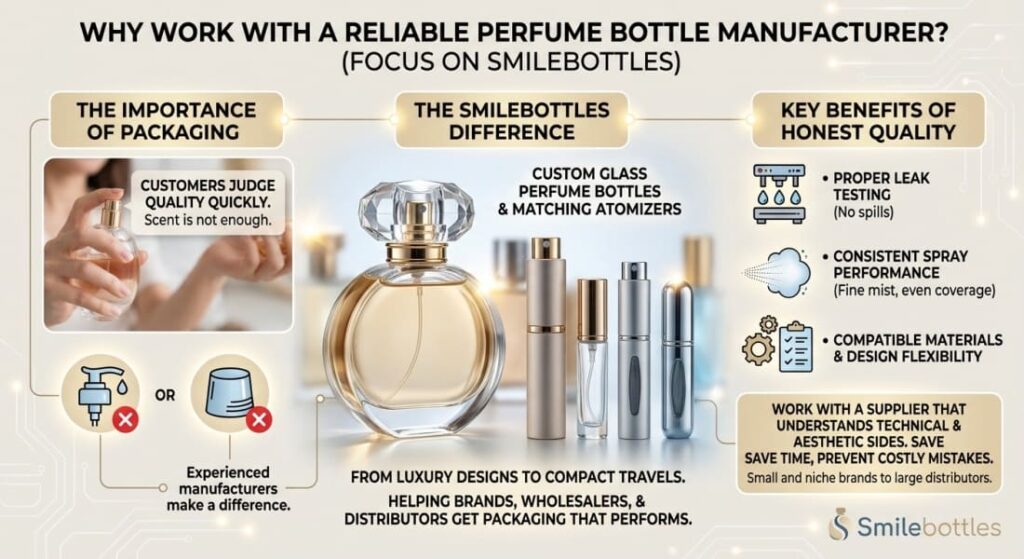
Why Work With a Reliable Perfume Bottle Manufacturer Such As Smilebottles?
If you’re building a fragrance brand, the packaging is just as important as the scent itself. Customers judge quality within seconds of picking up the bottle. A poor pump or a cheap-looking cap can drag down an otherwise great product.
That’s where working with an experienced manufacturer makes a real difference. At Smilebottles, the focus is on producing custom glass perfume bottles and matching atomizers that meet the needs of modern fragrance brands. From luxury glass perfume bottles to compact travel designs, the goal is to help brands, wholesalers, and distributors get packaging that performs well and looks the part.
What matters most in this kind of partnership is honest quality — proper leak testing, consistent spray performance, compatible materials, and design flexibility. Whether you’re a small niche brand or a large distributor, working with a supplier that understands both the technical and aesthetic sides of fragrance packaging saves time and prevents costly mistakes down the road.
FAQ: Frequently Asked Questions About Perfume Atomizer
Q1:Is a perfume atomizer the same as a spray bottle?
A1:They’re similar, but not identical. An atomizer specifically creates a fine mist through a controlled pump system. A general spray bottle might not produce the same fine mist quality.
Q2:Can all perfume bottles be refilled?
A2:No. Only bottles designed for refilling — usually with a removable spray head or a bottom-fill valve — can be reused. Crimped bottles are sealed permanently.
Q3:How long does a refillable atomizer last?
A3:With good care, a quality refillable atom for perfume glass or metal-collared design can last for years. The pump is usually the first part to wear out.
Q4:Do atomizers leak easily?
A4:Well-made ones don’t. Cheap atomizers often leak from the pump area or the collar. This is one of the biggest reasons to buy from a trusted manufacturer.
Q5:Are glass atomizers better than plastic?
A5:For most uses, yes. Glass looks better, feels premium, and doesn’t interact with fragrance oils. Plastic has its place for budget or travel-specific products.
Q6:What size is best for travel?
A6:Anything under 100ml (about 3.4 oz) is airline-friendly. Many people prefer 5–10ml for daily travel and 30–50ml for longer trips.
Conclusion
A perfume atomizer might look like a small detail, but it shapes how a fragrance is experienced — from the first spray to the way it settles on your skin. Whether you’re buying for yourself or sourcing bottles for a brand, understanding how atomizers work, what types are available, and what to look for in quality will save you time and money.
If you’re ready to explore custom options for your fragrance line, working with Smilebottles a specialist in glass perfume packaging can help you get the details right — from the shape of the bottle to the feel of the spray. That kind of attention to the small things is what separates a good fragrance product from a great one.
 English