
Table of Contents
ToggleAuthor: SmileBottles Editorial Team
Estimated Reading Time: About 12Minutes
Have you ever wondered about the history behind the glass bottles you see everywhere today? From your morning juice to your favorite perfume, glass bottles play a crucial role in packaging countless products. Understanding when glass bottles were invented helps you appreciate why they remain one of the most trusted packaging materials in modern times.
Glass bottles have a fascinating history that spans thousands of years. From ancient civilizations to today’s automated production lines, these containers have evolved from rare luxury items to everyday packaging essentials. Whether you’re a business owner looking for packaging solutions or simply curious about the origins of glass containers, this article Smilebottles will take you through the complete journey of glass bottle development.
When Was Glass Invented?
Before diving into when bottles were invented, you need to understand the origins of glass itself. Glass was invented around 3500 BCE, primarily in ancient Mesopotamia and Egypt. However, this early glass wasn’t used for bottles or windows as you might expect today.
The origin of glass traces back to accidental discoveries, possibly when ancient metalworkers noticed glassy residues forming in their furnaces. Early glassmakers created beads, ornaments, and small decorative objects rather than functional containers. Because glassmaking required high temperatures and specialized skills, glass items were considered valuable luxury goods reserved for the wealthy and powerful.
These first glass objects were far different from the clear glass bottle designs you see today. Ancient glass was often colored and opaque, containing impurities that gave it distinctive hues of blue, green, or amber. The journey from these simple decorative items to functional glass bottles would take another two millennia.
When Were Glass Bottles Invented?
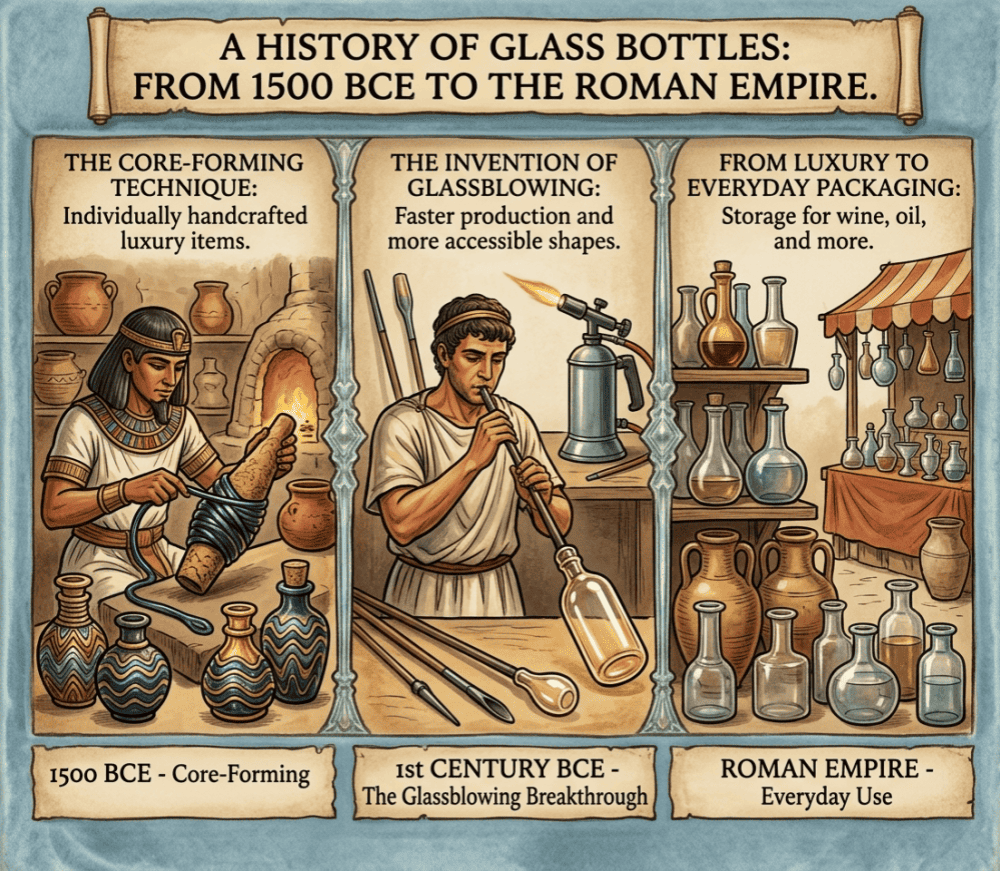
So, when were glass bottles invented? The first glass bottles appeared around 1500 BCE, marking a significant milestone in packaging history. These early containers were crafted by skilled artisans in Egypt and Mesopotamia who developed the core-forming technique to create small vessels for storing precious liquids.
Understanding where glass bottles come from begins with these ancient civilizations. Egyptian craftsmen created small glass bottles primarily for perfumes, oils, cosmetics, and medicines. These weren’t mass-produced items like today’s bottles – each piece was individually handcrafted and extremely valuable.
The real breakthrough in glass bottle history came around the 1st century BCE with the invention of glassblowing. This revolutionary technique transformed how glass bottles were made, making production faster and more affordable. During the Roman Empire, glass containers became increasingly common for storing wine, oil, and other liquids. This period truly established glass water bottles and other containers as practical storage solutions.
How Did Glass making Begin?
Early Materials Used in Glass making
The basic recipe for glass has remained surprisingly consistent throughout history. Ancient glassmakers discovered that combining silica sand, soda ash (or plant ash), and limestone at high temperatures created this remarkable material. Natural minerals added color variations, though achieving a clear glass bottle design would remain challenging for centuries.
You might wonder where do glass bottles come from in terms of raw materials. These same basic ingredients – sand, soda ash, and limestone – continue to form the foundation of modern glass production, though today’s manufacturers have perfected the ratios and added recycled glass to improve sustainability.
The Core-Forming Technique
Before glassblowing revolutionized the industry, artisans used the core-forming method to create the oldest glass bottle designs. This painstaking process involved:
Shaping a core from clay, sand, or mud to match the bottle’s interior
Wrapping hot, molten glass around this core
Cooling the glass completely
Carefully removing the core material
This technique produced small, thick-walled vessels that were labor-intensive and expensive. The limitations of core-forming meant that early bottle bottles remained luxury items rather than everyday packaging.
The Invention of Glassblowing
Glassblowing transformed the answer to “when did glass bottles become common?” This technique, developed around the 1st century BCE in the Syrian-Palestinian region, allowed artisans to create hollow glass containers by inflating molten glass with a blowpipe.
This innovation made glass bottles more accessible by:
Reducing production time dramatically
Enabling thinner, lighter bottle walls
Allowing for larger containers
Creating more consistent shapes and sizes
Making glass packaging affordable for everyday use
The Evolution of Glass Bottles Through History
Glass Bottles in Ancient Rome
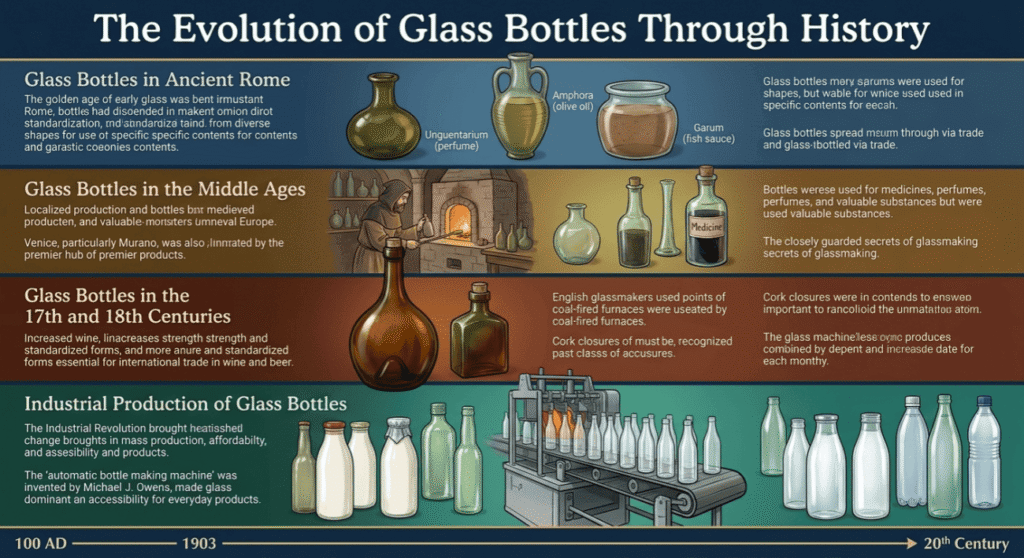
Roman glass bottles represent a golden age in early glass container development. The Romans embraced glass packaging for various products, from wine and oil to perfumes and garum (their famous fish sauce). Roman trade networks helped spread glass bottle technology throughout Europe and the Mediterranean.
During this period, glass bottles began appearing in diverse shapes and sizes, each designed for specific contents. Romans even developed early standardization, creating recognizable bottle forms that merchants and consumers could easily identify.
Glass Bottles in the Middle Ages
Following Rome’s fall, glass production continued but became more localized. Medieval glass bottles were often produced in monastery workshops or specialized glassmaking centers. Venice, particularly the island of Murano, emerged as Europe’s premier glassmaking hub, producing exquisite bottles that were traded across the continent.
During this era, glass bottle glass remained relatively expensive, primarily used for medicines, perfumes, and other valuable substances. The knowledge of glassmaking was closely guarded, with Venetian glassmakers forbidden from leaving the republic under penalty of death.
Glass Bottles in the 17th and 18th Centuries
This period saw significant advances in bottle strength and standardization. English glassmakers, using coal-fired furnaces, produced darker, more robust bottles perfect for wine and beer storage. The development of cork closures improved storage capabilities, making glass bottles essential for international trade.
You can trace many modern bottle shapes to this era. The wine bottle’s distinctive form, with its long neck and punt (indented bottom), became standardized during this period. These developments answered definitively “when were bottles invented” in their modern, recognizable form.
Industrial Production of Glass Bottles
The Industrial Revolution transformed glass bottle manufacturing. The late 19th and early 20th centuries brought mechanization that made glass bottles affordable for everyday products. The automatic bottle-making machine, invented by Michael J. Owens in 1903, revolutionized the industry by producing consistent, high-quality bottles at unprecedented speeds.
This innovation finally made glass water bottles and other containers accessible to average consumers, not just the wealthy. Mass production capabilities meant businesses could package everything from milk to medicines in glass, establishing it as the dominant packaging material of the early 20th century.
Why Glass Bottles Became Popular for Packaging
Understanding the benefits of glass bottles helps explain their enduring popularity. Unlike plastic bottles, which didn’t appear until the mid-20th century, glass offers unique advantages of glass packaging:
Glass bottles became the preferred packaging choice because they:
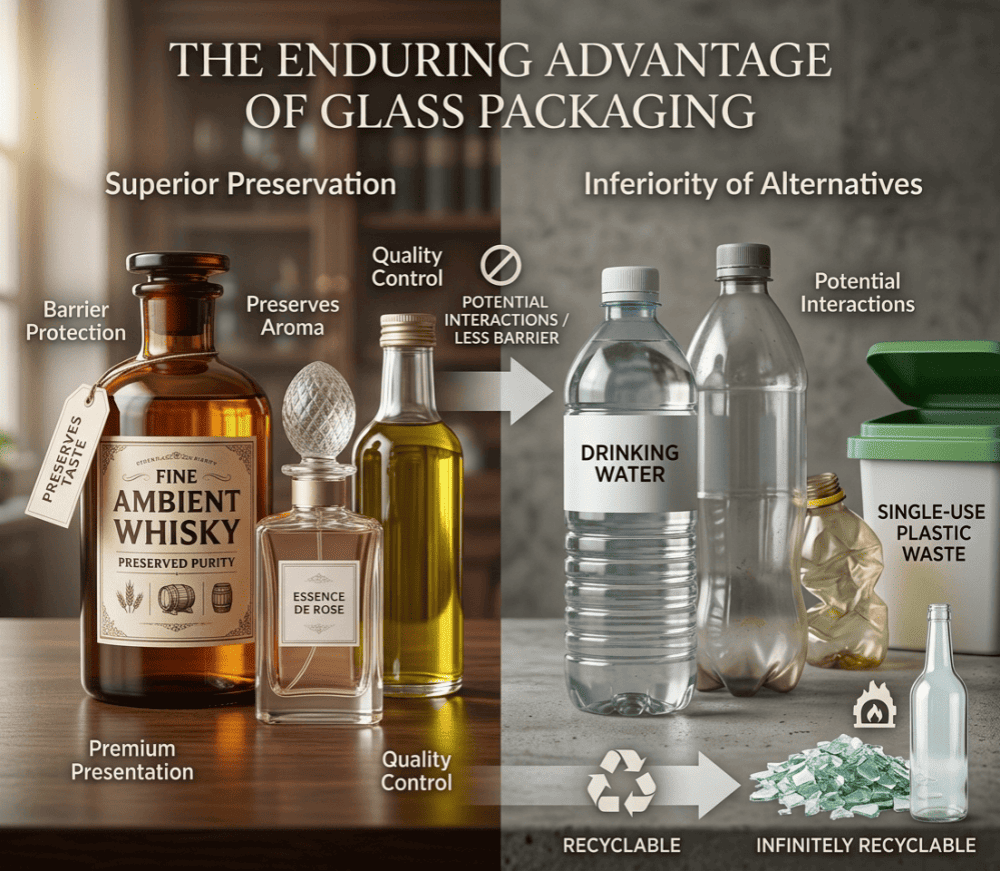
Don’t react chemically with contents
Preserve taste, aroma, and product quality perfectly
Offer complete barrier protection against air and moisture
Can be made transparent or colored for light protection
Provide premium product presentation
Are infinitely recyclable without quality loss
When comparing glass bottle where does it come from versus blastic bottle or plastic bottles, glass clearly offers superior product protection and environmental benefits. While plastic packaging has its uses, glass remains unmatched for preserving sensitive products like wines, perfumes, and medicines.
Modern Glass Bottle Manufacturing
Raw Materials for Modern Glass Bottles
Today’s glass bottle manufacturing process still relies on the same basic ingredients used millennia ago, with important additions. Modern manufacturers combine:
Silica sand (about 70% of the mixture)
Soda ash to lower melting temperature
Limestone for durability
Recycled glass (cullet) for sustainability
Various additives for color and properties
Understanding how glass bottles are made reveals why they remain competitive with modern alternatives like bottle bottles plastic options.
Main Steps in Glass Bottle Production
The glass bottle production process involves several precise steps:
Raw Material Preparation: You’ll find manufacturers carefully measuring and mixing ingredients to ensure consistent quality.
Melting: Materials are heated to approximately 1,500°C (2,732°F) in massive furnaces that run continuously.
Forming: Molten glass is shaped into bottles using either blow-and-blow or press-and-blow methods.
Annealing: Bottles pass through a controlled cooling process to relieve internal stresses.
Quality Inspection: Advanced systems check each bottle for defects.
Surface Treatment: Optional coatings improve durability and appearance.
Advantages of Modern Manufacturing
Modern production techniques have enhanced the traditional benefits of glass bottles. Today’s manufacturers can produce:
Ultra-lightweight bottles that reduce shipping costs
Specialty shapes for brand differentiation
Various colors from clear glass bottle designs to amber, green, and cobalt blue
Embossed logos and decorative elements
Precise threading for secure closures
Smilebottles: Glass Bottles for Different Packaging Needs
As a modern glass bottle manufacturer, Smilebottles continues the millennia-old tradition of glass packaging while embracing contemporary innovation. Understanding when were glass bottles invented and their evolution helps you appreciate the craftsmanship behind today’s packaging solutions.
Smilebottles’ Main Glass Bottle Product Lines
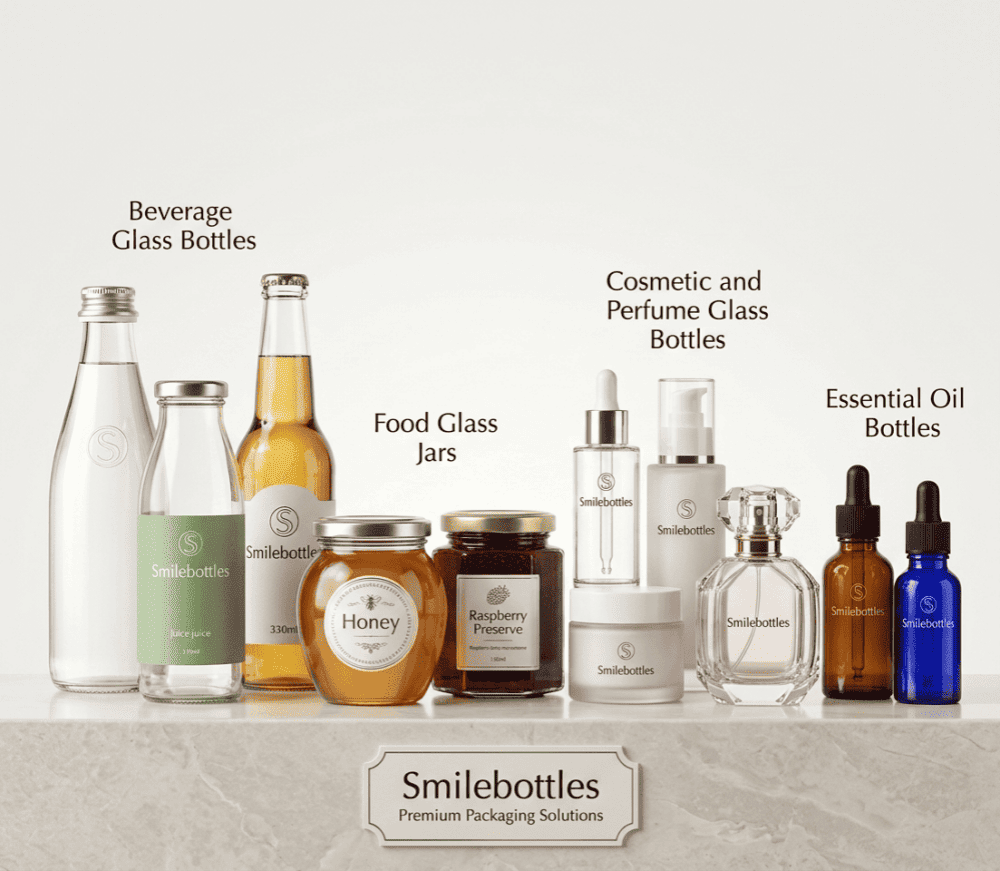
When you’re searching for a reliable glass bottles supplier, you need options that match your specific industry requirements. Smilebottles offers comprehensive product lines including:
Beverage Glass Bottles: From glass water bottles to juice containers, these bottles maintain freshness and purity while providing excellent shelf appeal.
Food Glass Jars: Perfect for sauces, honey, jams, and preserves, these containers protect flavor while showcasing product quality.
Cosmetic Glass Bottles: Elegant packaging solutions for serums, lotions, and beauty products that demand premium presentation.
Perfume Glass Bottles: Sophisticated designs that protect fragrances while enhancing brand luxury.
Essential Oil Bottles: Specialized amber and cobalt bottles that protect light-sensitive contents.
Custom Glass Bottle Options
As a leading custom glass bottle manufacturer, Smilebottles understands that your packaging needs are unique. Custom glass bottles services include:
Unique shape development to differentiate your brand
Custom capacity options from miniatures to large formats
Color customization beyond standard options
Logo embossing for permanent brand identification
Screen printing and hot stamping decoration
Frosting and coating treatments
Complete packaging solutions with matching closures
Why Choose Glass Bottles from Smilebottles?
When you’re evaluating wholesale glass bottles options, consider these advantages:
Extensive Experience: Drawing from the long history of glass bottles, Smilebottles combines traditional craftsmanship with modern technology.
Quality Assurance: Rigorous testing ensures every bottle meets international standards.
Sustainability Focus: High recycled content options support your environmental goals.
Flexible Order Quantities: Whether you need small batches or large-scale production, solutions are available.
Technical Support: Expert guidance helps you choose optimal packaging for your products.
FAQ: Frequently Asked Questions About Glass Bottles
Q1: When were bottles invented?
A1: The first bottles made from glass appeared around 1500 BCE in ancient Egypt and Mesopotamia. However, bottles made from other materials like clay and leather existed even earlier.
Q2: When was glass invented?
A2: Glass itself was invented around 3500 BCE, about 2,000 years before the first glass bottles were created. Early glass was used primarily for decorative objects and beads.
Q3: Who invented glass bottles?
A3: There’s no single inventor of glass bottles. Ancient Egyptian and Mesopotamian craftsmen developed the first glass containers, while Syrian glassmakers later invented the glassblowing technique that revolutionized bottle production.
Q4: When is glass invented compared to other materials?
A4: Glass was invented after pottery (around 20,000 BCE) but before many other materials we use today. It predates paper, steel, and certainly plastic bottles by thousands of years.
Q5: Where does a glass bottle come from?
A5: Glass bottles come from heating natural materials – primarily sand, soda ash, and limestone – to extreme temperatures. Today’s bottles often include recycled glass from previous bottles.
Q6: Are glass bottles recyclable?
A6: Yes, glass bottles are 100% recyclable and can be recycled endlessly without losing quality. This makes them more sustainable than plastic bottles, which degrade during recycling.
Q7: Why are glass bottles better than plastic?
A7: Glass bottles offer superior product protection, don’t leach chemicals, preserve taste better, and are infinitely recyclable. Unlike plastic, glass doesn’t absorb flavors or odors from previous contents.
Q8: When did glass bottles become common?
A8: Glass bottles became common in two major waves: first during the Roman Empire (1st-4th centuries CE) for the wealthy, then after the invention of automatic bottle-making machines in the early 1900s for mass market use.
Q9: What is the oldest glass bottle ever found?
A9: The oldest glass bottle specimens date to around 1500 BCE from ancient Egypt. Some well-preserved Roman glass bottles from the 1st century CE can be found in museums worldwide.
Q10: How has glass bottle manufacturing changed over time?
A10: From hand-forming individual bottles in ancient times to today’s automated systems producing millions daily, the basic process remains similar, but speed, precision, and customization options have improved dramatically.
Conclusion
The history of glass bottles shows us that some packaging solutions truly stand the test of time. While plastic bottles and other alternatives have emerged, glass remains unmatched for product protection, sustainability, and premium presentation.
If you’re looking for a trusted partner in glass packaging, Smilebottles combines this rich heritage with contemporary manufacturing excellence. Whether you need beverage glass bottles, food glass jars, cosmetic glass bottles, perfume glass bottles, or essential oil bottles, you’ll find solutions that honor glass packaging’s storied past while meeting today’s demanding requirements. From standard designs to custom glass bottles that set your brand apart, Smilebottles helps you leverage the timeless advantages of glass packaging for modern market success.