
Table of Contents
ToggleAuthor: SmileBottles Editorial Team
Estimated Reading Time: About 16 Minute
If you’re running a fragrance business, or you’re a buyer trying to source packaging that won’t let your brand down, you’ve probably already noticed that glass shows up everywhere in this industry. Plastic bottles exist too, sure, but they rarely show up on the shelves of brands that care about how their product is perceived. So what’s actually going on here? Why does the fragrance world keep coming back to the same material, decade after decade?
This article breaks that down — the practical reasons, the history behind it, the design possibilities, and what actually matters when you’re picking a supplier for your own glass perfume bottles. Whether you’re launching a new fragrance line or just trying to understand your perfume bottle materials options better, you should walk away from this with a clearer picture of what makes sense for your product.
Why Glass Is the Preferred Material for Perfume Bottles
Let’s get straight to it, since this is probably the question that brought you here.
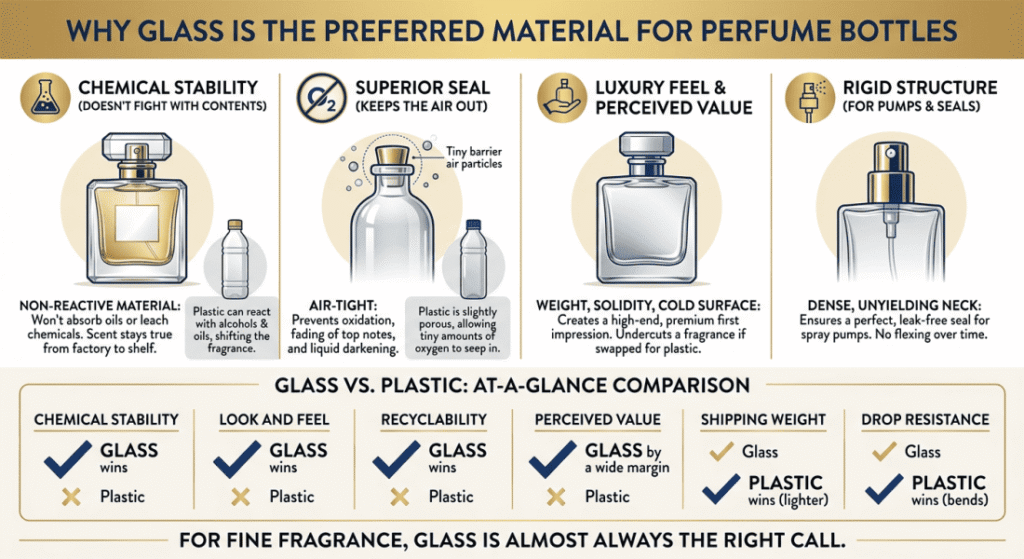
It Doesn’t Fight With What’s Inside It
Perfume is a chemical mix — alcohol, essential oils, aromatic compounds. Some of that mix is pretty reactive. Put it in the wrong container and, over time, things start to go wrong. Smells shift. Liquid discolors. Sometimes the container itself breaks down a little.
Glass sidesteps all of that because it’s non-reactive. It won’t absorb the oils, it won’t leach anything back into the perfume, and it won’t slowly change the scent over the months a bottle sits on a shelf. What goes into the bottle at the factory is basically what your customer smells a year later.
Plastic can’t always say the same. Certain alcohols and oils interact with plastic on a molecular level, and depending on the resin used, you can end up with a fragrance that smells slightly different than it did on day one. If you’ve ever noticed a cheap perfume smelling “off” after sitting around a while, that’s often the packaging, not a bad formula.
It Actually Keeps the Air Out
Oxygen is the enemy here. Once air starts getting into a bottle, oxidation kicks in, the top notes fade faster than they should, and the liquid can darken. Plastic, even good plastic, is slightly porous — tiny amounts of oxygen do sneak through eventually. Glass doesn’t have that problem. A well-sealed perfume glass bottle locks air out almost completely, which matters a lot when your stock might sit in a warehouse for months before it even reaches a store shelf.
It Feels Expensive, Because It Is
Here’s something you can’t really fake with plastic: weight. When someone picks up your bottle, they’re making a snap judgment in less than a second — how heavy it is, how solid the cap feels, whether it clicks shut with a satisfying sound. That first impression happens before they even open the box.
This is exactly why so much luxury perfume packaging relies on glass. The weight, the cool surface, the density — all of it tells your customer “this was worth paying for.” Swap in lightweight plastic and you undercut a fragrance you probably spent months developing.
It Holds Its Shape Under Pressure
Plastic flexes. Glass doesn’t. That rigidity is exactly what a spray pump needs to seal properly. A glass spray bottle for perfume gives you a firm, precise neck that a pump can lock into without leaking or losing pressure over time. Anyone who’s dealt with a flimsy plastic sprayer that stops working after a few weeks knows exactly what that flexing does to a product.
Glass vs. Plastic, Side by Side
You might be thinking plastic still makes sense somewhere, and honestly, sometimes it does. Here’s the quick version:
Chemical stability — glass wins, no contest.
Look and feel — glass wins.
Recyclability — glass wins, hands down.
Shipping weight — plastic wins, it’s lighter.
Drop resistance — plastic wins, it bends instead of shatters.
Perceived value — glass, by a wide margin.
For fine fragrance, glass is almost always the right call. Plastic still has a place — travel sprays, bulk body mists, that kind of thing — but you won’t find it sitting next to a premium bottle on a department store counter, and there’s a reason for that.
The History of Glass Perfume Bottles
It’s worth a quick look back, because this history is part of why glass still carries that association with quality today.
Before Glass, People Used What They Had
Ancient Egyptians carved perfume containers out of alabaster. Mesopotamians used clay. Wealthy Romans sometimes had scented oils stored in bone or metal, often hand-engraved. None of these were great solutions — heavy, opaque, and prone to soaking up the very scent they were supposed to protect.
Glass entered the picture around 1500 BCE, when Egyptian craftsmen figured out early core-forming techniques for small vessels. The glass wasn’t clear or perfect — cloudy, a bit rough — but people noticed something important almost immediately. It didn’t absorb the oil the way other materials did.
Then It Became a Luxury Item in Its Own Right
By the Renaissance, Venetian glassmakers had figured out how to produce clear cristallo glass, and perfume bottles turned into small works of art almost overnight. European nobility wanted their fragrances housed in something as refined as the scent itself, not just a plain container.
Fast forward a few centuries, and partnerships like Baccarat with Guerlain, or Lalique with Coty, basically cemented the idea that a perfume bottle deserves to be collectible on its own. Not just a perfume holder — a piece worth displaying long after the perfume is gone.
And Then Production Caught Up
Once glassmaking scaled to industrial levels, it became affordable enough for mass-market fragrances while somehow keeping its upscale reputation intact. That’s a pretty rare combination — cheap enough to produce at volume, but still carrying a premium feel. It’s a big part of why both boutique fragrance houses and massive global brands still build their packaging around glass.
The Visual Appeal of Glass Perfume Packaging
Now for the part your customer actually notices first — how the thing looks and feels in their hand.
Transparency Builds a Kind of Trust
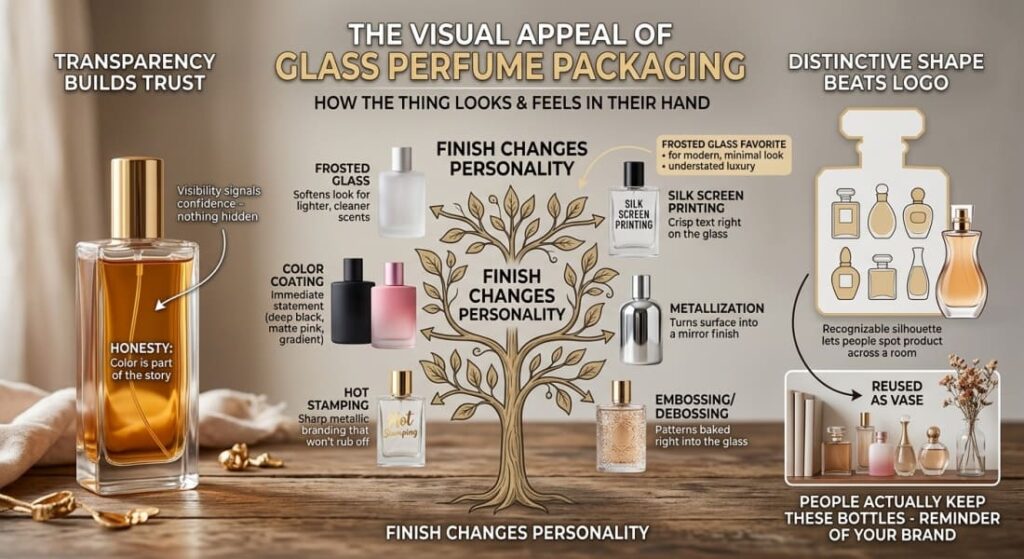
Clear glass has an honesty to it. Your customer can see exactly what color the liquid is, and that visibility signals confidence — there’s nothing hidden here. If your fragrance has a warm amber hue or a soft blush tone, clear glass turns that color into part of the story you’re telling.
The Finish Changes the Whole Personality of the Bottle
You don’t have to stick with plain clear glass, though. Some of the most memorable decorative glass perfume bottles rely on finishing techniques that completely shift how the product feels:
Frosting, which softens the look and works well for lighter, cleaner scents
Color coating, where colored glass perfume bottles in deep black, matte pink, or gradient tones make an immediate statement
Hot stamping, which adds sharp metallic branding that won’t rub off
Silk screen printing, ideal for crisp text right on the glass
Metallization, which turns the surface into a mirror finish
Embossing or debossing, patterns baked right into the glass itself
Frosted glass perfume bottles, in particular, have become a favorite for brands going after a modern, minimal look. There’s something about the matte surface that reads as more understated luxury than shiny clear glass ever could.
A Distinctive Shape Beats Any Logo
Think of a Chanel N°5 bottle. You probably pictured it instantly, without needing a description. That’s what a strong perfume bottle design can do for a brand. A recognizable silhouette lets people spot your product across a room before they’ve even read the label. That’s worth more than most marketing budgets can buy.
People Actually Keep These Bottles
Here’s something that says a lot about how well-designed glass packaging performs — plenty of people don’t throw the bottle away once the perfume runs out. It ends up on a shelf, on a dresser, sometimes reused as a small vase. That’s packaging doing its job well past the point of sale, and it’s a reminder of your brand every time someone glances at it.
Sustainability Benefits of Glass Perfume Bottles
This part matters more to your customers than it used to, so it’s worth spending real time on.
Glass Can Be Recycled Basically Forever
Unlike plastic, which loses a bit of quality every time it’s recycled, glass can be melted down and reformed over and over without any real degradation. That makes it one of the genuinely circular perfume bottle materials out there right now.
Refill Systems Are Catching On Fast
For a long time, most bottles used crimped necks that couldn’t be reopened once the pump went on. Once the perfume ran out, the whole thing went in the bin.
That’s changing. Refillable perfume bottles are turning into something customers actively expect, especially in the premium space. Switch to a screw-neck design instead, and your customer can top the bottle back up from a smaller refill pouch rather than buying a whole new container. Less waste, and it keeps people coming back to buy refills instead of switching to a competitor.
It Fits the Premium Sustainability Story Pretty Naturally
If you’re positioning your brand at the higher end, customers now expect you to have thought about environmental impact. Sustainable perfume packaging isn’t a bonus feature at that level anymore — it’s assumed. Glass gives you a legitimate story here, not just marketing language: it’s recyclable, reusable, and built to last well beyond one use.
A Fair Note, Since Nothing’s Perfect
To be fair, producing glass does take real energy, and it’s heavier to ship than plastic, which adds to transport emissions. That’s a real tradeoff, not something to gloss over. But once you factor in how many times one glass bottle can be recycled or refilled, the long-term picture tips heavily in glass’s favor. Lightweight bottle engineering and smarter production methods are closing that gap even further every year.
Custom Glass Perfume Bottles: Design and Decoration Options
If you actually want your product to stand out on a crowded shelf, this is where the real decisions happen.
Shapes and Sizes You Can Work With
You can start with a standard shape straight from a supplier’s catalog, or go further and commission a fully custom perfume bottle design built around your own mold. Common sizes across the industry include:
10ml for travel or discovery formats
30ml, a common entry price point
50ml, a popular middle-ground size
100ml glass perfume bottle, usually the flagship retail size for a full-price product
Which one you pick depends on your price point, where you’re planning to sell, and how your customer actually uses the product day to day.
Color, Finish, and Everything on the Surface
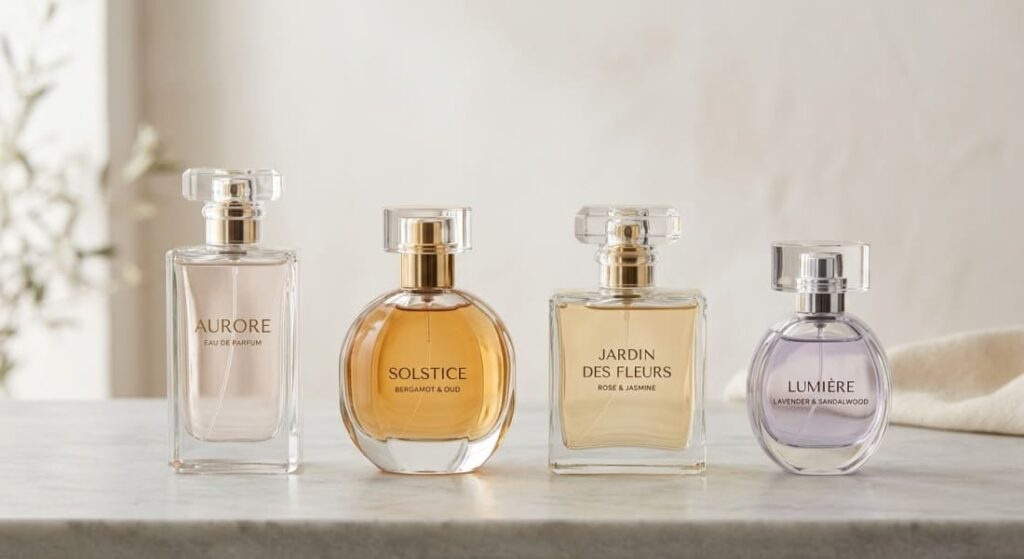
All the finishes mentioned earlier can be layered and combined. A deep blue gradient bottle with a gold hot-stamped logo tells a completely different story than a plain frosted white bottle with debossed lettering. Both can work well — it really comes down to what you’re trying to say about the fragrance inside.
Closures Matter as Much as the Bottle Itself
The bottle is only half of it. Common options include:
FEA 15 crimp pumps, the industry standard for fine fragrance
Screw-neck pumps, built specifically for refill systems
Glossy Surlyn caps, which add a heavier luxury feel
Wooden caps, for a warmer, more natural look
Aluminum caps with weighted inserts
Magnetic closures, which make for a more memorable unboxing moment
Getting the pump, collar, and cap to match the bottle correctly is what pulls the whole package together into something that feels finished, not thrown together.
Custom Packaging Gives Smaller Brands Real Leverage
If you’re a smaller or niche brand going up against companies with much bigger marketing budgets, packaging becomes one of your best tools. A well-designed bottle does marketing work every single time it sits on a shelf, gets photographed, or shows up in an unboxing video. Custom design isn’t just decoration in that case — it’s often how smaller brands manage to compete at all.
How to Choose the Right Glass Perfume Bottle Manufacturer
This is where a lot of buyers run into trouble, so it’s worth slowing down here rather than rushing the decision.
Look Closely at Quality and Consistency
Check for:
Clarity — cheap glass often has a slight green tint or visible bubbles
Weight consistency — every bottle in a batch should weigh roughly the same
Neck precision — if the opening is even slightly off, pumps won’t seal right, and you’ll deal with leaks later
A flat, stable base — bottles need to stand without wobbling
Surface quality — watch for waviness or small defects in the glass
Always ask for physical samples before placing a full order. Photos on a website hide a lot of small problems that only show up once you’re holding the actual bottle.
Ask What They Can Actually Customize
A solid custom perfume bottle manufacturer should be able to offer custom mold development, several decoration methods in-house, OEM and ODM support, design renderings before production starts, and prototype samples ahead of the full run. If a factory can only handle one or two of those things, you’ll end up juggling multiple suppliers just to finish one product, which slows everything down.
Ask About Minimum Order Quantities and Capacity
If you’re a smaller brand, you need a supplier willing to work with lower minimum order quantities. If you’re scaling up, you need one that can genuinely deliver wholesale glass perfume bottles at volume without stretching your timeline out for months. Ask directly about typical lead times — don’t just assume.
Check Their Shipping and Packing Process
Find out how bottles actually get packed for export. They should be separated individually with cardboard dividers, boxed securely, palletized, and reinforced at the corners. A supplier who ships bottles loosely packed in weak boxes is basically setting you up for a container full of broken glass — it happens more often than you’d think.
Confirm Certifications and Quality Control
Ask whether they run documented inspections — raw material checks, mid-production quality control, and pre-shipment review. This kind of process is usually what separates a dependable perfume bottle manufacturer from someone who’s just filling orders without much oversight behind the scenes.
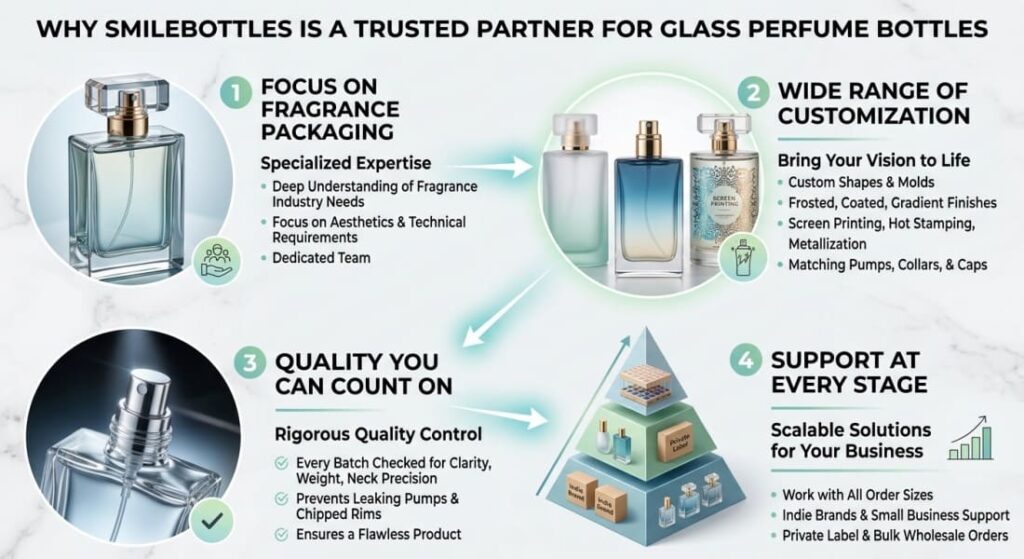
Why Smilebottles Is a Trusted Partner for Glass Perfume Bottles
By now you’ve probably got a good sense of what to look for. Here’s how we fit into that picture, in case you’re weighing your options.
We Focus Specifically on Fragrance Packaging
At Smilebottles, glass bottles for perfume are what we do — not a side project alongside a dozen other product lines. That focus means we understand the technical requirements and the aesthetic expectations that come with this category specifically, rather than treating a perfume bottle the same way we’d treat a lotion pump.
A Wide Range of Customization Support
Whether you’re browsing our existing catalog of empty glass perfume bottles or building something completely custom from scratch, we can help with custom shapes and molds, frosted or coated or gradient finishes, screen printing, hot stamping, embossing and metallization, and matching pumps, collars, and caps. If you’ve got a rough sketch or even just an idea in your head, our design team can help turn it into a working prototype.
Quality You Can Actually Count On
Every batch we produce gets checked for clarity, weight, neck precision, and surface quality. We’ve seen firsthand what a leaking pump or a chipped rim can do to a product launch, so we pay close attention to those details long before anything ships out.
Support at Whatever Stage You’re At
We work with indie brands placing their first small order, private label buyers testing a new idea, and larger companies placing recurring perfume bottle wholesale orders. Wherever you currently stand, we can usually find a way to work within that.
If you’re exploring custom glass perfume bottles or luxury glass perfume bottles for an upcoming launch, we’re happy to talk through your ideas and figure out what actually fits your budget and your goals — no pressure, just a conversation.
FAQ: Frequently Asked Questions About Glass Perfume Bottles
Q1:Why are perfume bottles usually made of glass instead of plastic?
A1:Glass doesn’t react with the alcohol and oils in perfume, so the scent stays stable over time. It also feels more premium in the hand and holds its shape well under the pressure of a spray pump. Plastic can react with certain fragrance chemicals and just doesn’t carry the same upscale feel.
Q2:Do glass perfume bottles keep fragrance fresh longer?
A2:Yes. Glass creates a solid barrier against oxygen and outside contamination, which helps preserve a scent’s original character for much longer. That’s a big part of why fragrance glass is still the default choice in fine perfumery.
Q3:Are glass perfume bottles recyclable?
A3:Yes, and unlike plastic, glass doesn’t lose quality when recycled — it can be melted and reformed again and again. The specifics depend on your local recycling program, but the material itself is genuinely sustainable.
Q4:Can glass perfume bottles be customized?
A4:Definitely. Shape, size, color, finish, decoration, closure type — all of it can be adjusted. Suppliers usually offer both standard molds and fully bespoke designs depending on your order size and budget.
Q5:Aren’t glass bottles too fragile for shipping?
A5:Glass is more fragile than plastic, no question there. But with proper wall thickness, good packing materials, and palletized shipping, breakage rates stay pretty low in practice. This mostly comes down to how well your supplier handles the packing process.
Q6:What sizes do glass perfume bottles usually come in?
A6:Common sizes include 10ml, 30ml, 50ml, and 100ml, with custom sizes available for special projects. The 100ml size tends to be the most popular for a standard full-price retail product.
Q7:Can perfume glass bottles be reused or refilled?
A7:Yes. Screw-neck designs let a customer unscrew the pump and refill the bottle from a smaller flask, which is quickly becoming a standard feature rather than a niche extra.
Q8:How do I choose the right perfume bottle supplier?
A8:Focus on product quality, customization ability, flexibility on minimum order quantities, realistic lead times, and shipping reliability. Always ask for samples first. If a perfume bottle supplier hesitates to answer technical questions or avoids sending samples, take that as a warning sign and keep looking.
Conclusion
Whether you’re launching your first fragrance line or scaling one that’s already working, the bottle you choose shapes how your customer feels about your product before they’ve even opened it. That’s worth taking seriously. Ask the hard questions, request samples, and pick a supplier who actually understands this category instead of treating it like any other bottle order.
If you’d like to talk through your next project, the Smilebottles team is ready to help turn your packaging ideas into bottles your customers will actually want to keep around.
 English