
Table of Contents
ToggleAuthor: SmileBottles Editorial Team
Estimated Reading Time: About 15 Minute
If you’ve walked down the spirits aisle lately, you’ve probably noticed something interesting. Among the tall, elegant whiskey decanters and the frosted vodka silhouettes, there’s a growing family of bottles that look almost like they belong in a barn from a hundred years ago. Short necks, jug-style handles, thick glass shoulders, mason-jar echoes. These are moonshine bottles, and they’ve quietly become one of the most talked-about categories in spirit packaging.
For anyone sourcing packaging for a distillery, private label, or import business, understanding why these bottles work — and how to buy them well — matters more than it used to. This article walks you through the history, the design language, the technical side, and the buying decisions that go into choosing the right moonshine-style bottle for your spirit brand.
Why Moonshine Bottles Still Matter in Today’s Spirits Market
You might assume moonshine bottles are a niche product tied only to a niche category of spirits. That used to be true. It isn’t anymore.
Today, moonshine bottles are used across whiskey, rum, gin, vodka, flavored spirits, ready-to-drink cocktails, and even non-alcoholic craft beverages. What started as a container for backcountry distillers has become one of the most versatile and expressive shapes in the world of glass bottles for spirits. If you’re looking at wholesale liquor bottles for a new product line, the moonshine style gives you something most modern bottles struggle to offer: instant character.
Consumers respond to bottles that tell a story. A rustic jug on the shelf feels handmade, small-batch, and honest — even when the liquid inside comes from a large facility. That emotional pull is why craft distilleries, premium spirit brands, and even mainstream producers keep coming back to this design language.
Throughout this article, you’ll get a practical look at how these bottles evolved, what makes them work, and how to source them properly as a buyer.
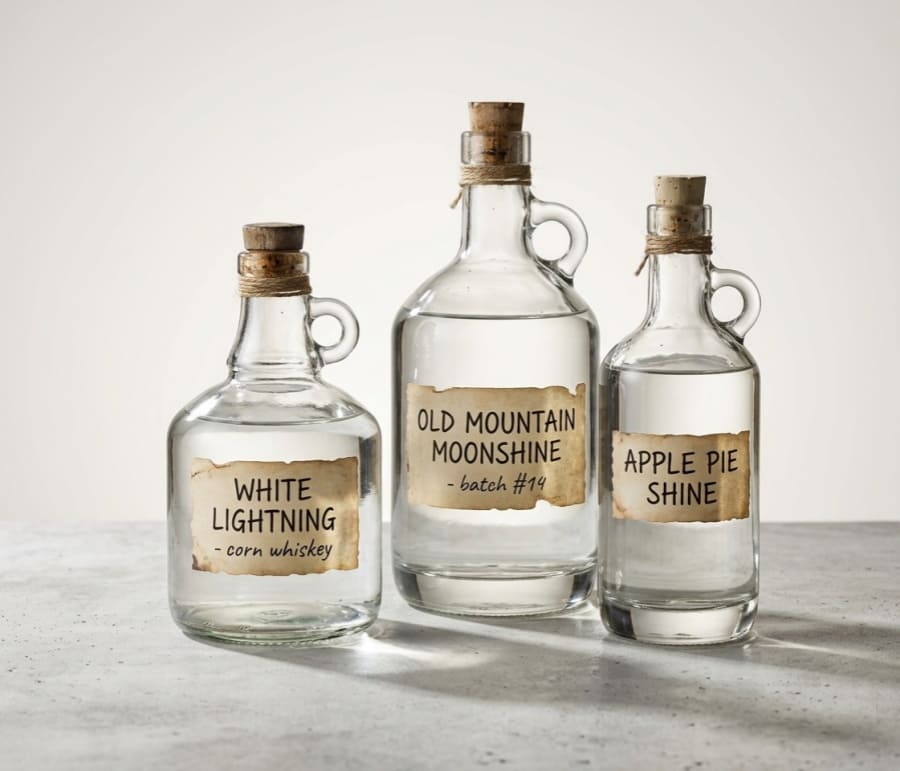
From Prohibition-Era Utility to Premium Branding: The Legacy of Moonshine Bottles
The historical roots of moonshine packaging
Moonshine’s early containers weren’t designed. They were borrowed. Distillers in the Appalachian regions of the United States used whatever glass they could get their hands on — jars, jugs, reused bottles — because their product often needed to be concealed, moved quickly, or bartered. Mason jars became the unofficial standard because they were cheap, strong, and easy to seal.
That practical, homemade look is exactly what today’s brands are trying to recapture.
How moonshine bottles became a cultural symbol
Once Prohibition passed and spirits went legal again, the imagery stayed. Movies, music, and rural American culture kept the moonshine jug alive as a symbol of independence and craftsmanship. When craft distilling exploded in the 2000s, that symbolism was ready to be picked up again.
The transition into commercial spirit packaging
Craft distilleries realized quickly that their story needed a face. A generic round bottle didn’t say “small-batch.” A moonshine-inspired bottle did. This is when you started seeing serious investment in custom liquor bottles shaped after old jug forms — but produced with modern glass quality, tight tolerances, and clean finishes.
Why the heritage look sells in modern markets
You can price a bottle higher when it feels authentic. That’s the simple truth behind luxury liquor bottles built on heritage cues. Buyers pay for a feeling, and a well-made moonshine bottle delivers one before the cap even comes off.
What Defines a Classic Moonshine Bottle Design?
If you’re planning to order liquor glass bottles wholesale, understanding the design vocabulary will save you a lot of back-and-forth with your supplier.
Shape and silhouette
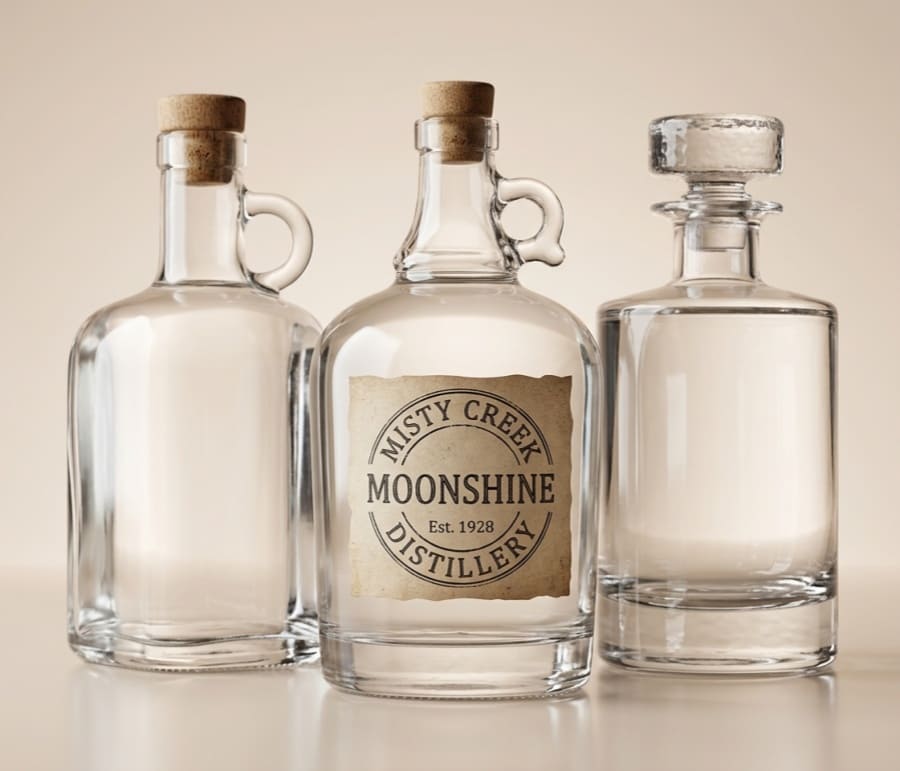
Most moonshine bottles fall into a few families: the round jug, the square-shouldered flask, the mason-jar cylinder, and the handled growler style. What they share is a low, solid stance. They feel planted. That grounded look is part of what makes them read as “authentic” instead of “decorative.”
Glass thickness and tactile appeal
Pick up a moonshine bottle and you’ll notice the weight right away. Thick walls, heavy bases, and substantial shoulders all tell your customer the product inside is worth the price. For premium liquor bottles, this tactile signal is more important than most designers admit.
Neck finish and closure options
You’ve got real flexibility here. A liquor bottle with cork feels traditional and works beautifully for sipping spirits. Screw caps are practical for higher-volume products. Bar-top closures with T-corks bridge the two worlds. Swing-top and lug finishes show up in specialty formats. Your choice affects both cost and shelf presence.
Handle, grip, and pouring functionality
Some moonshine bottles come with integrated handles — a direct nod to the old jug form. Handles look great in photos and pour well behind the bar, but they add cost and complicate packing. Worth considering if your brand story leans hard into tradition.
Labeling and decoration possibilities
Pressure-sensitive labels, screen printing, embossing, debossing, frosting, spray coating, and shrink sleeves all work well with moonshine bottle shapes. Wide, flat panels give your label designer plenty of room, which is one reason these bottles perform well for unique liquor bottle designs.
Color choices in modern moonshine bottle design
Flint (clear) glass lets the product speak. Amber adds heritage warmth and blocks UV. Colored liquor bottles in green, blue, or smoke are becoming more common for brands that want visual separation on the shelf. Frosted liquor bottles give a soft, premium feel that works especially well for infused or flavored spirits.
Understanding Liquor Bottle Sizes and Dimensions
Size is where a lot of first-time buyers get tripped up. Let’s clear it up.
Standard liquor bottle sizes you should know
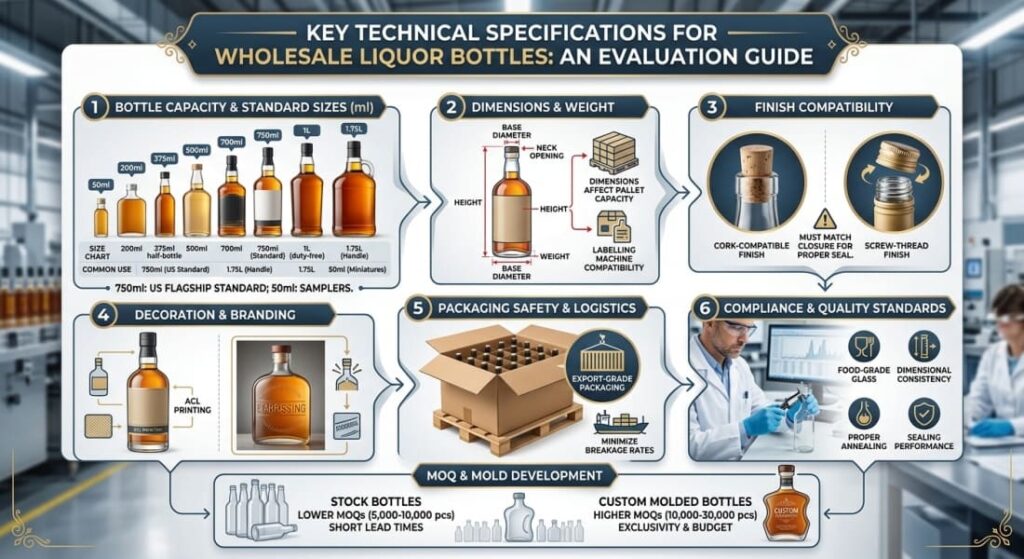
If someone asks you what the standard liquor bottle sizes are, the short answer is 50ml, 200ml, 375ml, 750ml, and 1.75L in the U.S. market, and 700ml as the norm in most other regions. Keep a liquor bottle size chart handy when you’re planning across export markets — the mismatch between 700ml and 750ml alone has caused headaches for plenty of importers.
Why liquor bottle dimensions matter beyond volume
Two 750ml bottles can hold the same amount and still be completely different in height, diameter, and shoulder width. Liquor bottle dimensions affect your carton size, pallet count, shipping cost, and shelf placement. A tall thin bottle might look elegant but eat up vertical shelf space you don’t have. A short wide bottle might not fit standard gift boxes.
Always request full technical drawings before you commit to a mold. Height, body diameter, neck finish specs, and base dimensions all need to match your downstream packaging.
Key Technical Specifications Buyers Should Evaluate
Before you place a wholesale order, run through this checklist with your liquor bottle supplier.
Weight and glass quality
Lightweight bottles cost less to ship and reduce your carbon footprint. Heavy-bottom bottles feel more premium and hold up better in retail handling. Neither is universally better — it depends on your positioning.
Finish compatibility
Your bottle finish has to match your closure exactly. Mismatched threads or cork bore sizes cause leaking, contamination, and returns. Confirm the finish spec (GPI, GME, or custom) in writing.
Decoration and branding compatibility
If you plan to emboss a logo, tell your liquor bottle manufacturer at the mold stage. Retrofitting embossing later means a new mold. Screen printing and ACL work best on smooth, defined panels — plan the design around the bottle, not the other way around.
Packaging safety and logistics
Ask about pallet configuration, carton strength, dividers, and shrink wrapping. For export orders, confirm the bottle is tested for stacking and drop resistance. A cheap bottle that arrives broken costs more than a good bottle that arrives whole.
Compliance and quality standards
Food-grade glass, dimensional consistency, and sealing performance should all be documented. Ask for QC reports. Reputable suppliers will provide them without hesitation.
MOQ and mold development
Stock bottles typically ship with MOQs starting around 1,000 to 3,000 pieces depending on the size and factory. Custom glass bottles for liquor — meaning a new mold — usually start at 10,000 to 30,000 pieces per run, with mold fees added upfront. Lead times run 30 to 60 days for stock and 60 to 90 days for custom.
Why More Spirit Brands Are Choosing Moonshine-Style Bottles
Shelf impact in a crowded market
When you’re looking at fifty whiskey bottles on a shelf, the one shaped like a jug stops your eye. That’s real commercial value. Whiskey bottles wholesale in traditional shapes get lost quickly; moonshine-style shapes cut through.
Storytelling and brand authenticity
If your brand talks about craft, tradition, or small-batch production, your bottle needs to back that up. A moonshine bottle is a shortcut to that story. Buyers of custom spirits bottles know this well.
Premiumization through heritage cues
You can charge more for a bottle that feels handmade. Consumers reward packaging that looks intentional, and heritage-style bottles score high on this metric.
Versatility across spirit categories
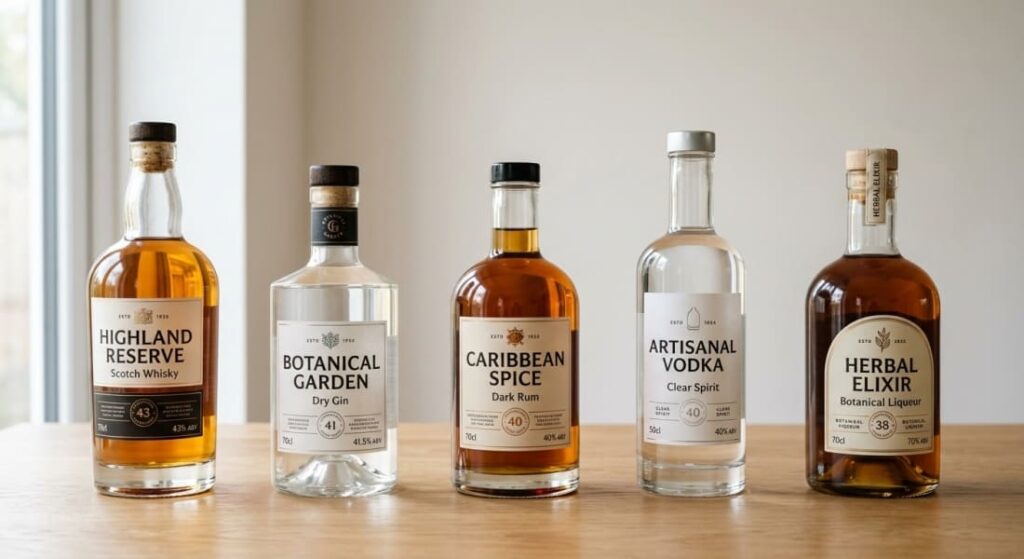
The same bottle shape works for vodka bottles wholesale, gin bottles wholesale, rum bottles wholesale, whiskey, and flavored spirits. That flexibility is useful for brands with multiple SKUs.
Appeal to craft and private-label brands
Smaller brands don’t have the marketing budget to build recognition through advertising alone. Their packaging has to do the work. A moonshine bottle gives a new brand instant personality — one of the reasons empty liquor bottles wholesale in this style sell well to startups.
Social media and visual branding
Distinctive bottles photograph well. That matters more than ever now that most product discovery happens on a phone screen.
How to Choose the Right Moonshine Bottle for Your Spirit Brand
Start with your brand positioning
Are you rustic and traditional? Modern and premium? Playful and flavored? Your bottle should agree with your brand voice before it agrees with anything else.
Match the bottle to the spirit
Whiskey wants weight and warmth. Vodka wants clarity and cleanliness. Flavored spirits benefit from clear glass that lets the color show. Think about what your product looks like inside the bottle.
Consider your target market
Retail shelves demand strong shelf impact. Gift buyers want bottles worth keeping. Bar programs want bottles that pour cleanly and stack well. Export markets may have specific size requirements — this is where knowing your liquor bottle sizes across regions matters.
Balance design with budget
Stock bottles keep your first run affordable and your lead times short. Custom molds cost more upfront but give you a shape no one else can copy. Many brands start with stock and move to custom once volume justifies it.
Choose the right closure
A liquor bottle with cork costs more per unit but signals premium. Screw caps are efficient and reliable. Bar-top corks are the middle ground and work particularly well with moonshine shapes.
Think about decoration early
Plan your label area, embossing, and cap style together, not separately. Decoration decided late in the process almost always costs more.
Work with an experienced manufacturer
Ask your liquor bottle manufacturer about their experience with your specific style. Look at samples. Request references. A good supplier will save you money over time even if their unit price isn’t the lowest.
Stock Bottles vs Custom Bottles: Which One Fits You?
This is one of the most common questions from buyers, so let’s address it directly.
Stock moonshine bottles work best if you want lower upfront cost, faster lead times, and lower risk. They’re ideal for startups, small production runs, and brands still testing the market.
Custom moonshine bottles work best if you want exclusive branding, unique embossing, and a shape no competitor can order. They require higher MOQs, mold fees, and longer development, but they build stronger brand equity over time.
Many brands run both — stock bottles for entry-level SKUs and custom bottles for flagship products.
Manufacturing Innovation in Modern Moonshine Bottle Production
The moonshine bottles you can buy today aren’t the same as the ones from twenty years ago. Manufacturing has come a long way.
Precision molding and consistency
Modern machines produce bottles with tighter dimensional tolerances, which means your closures fit properly every time and your labels line up cleanly. This matters more than it sounds — inconsistent bottles slow down your bottling line and cost you money.
Custom mold development
If you want an exclusive shape, your manufacturer will guide you through 3D drawings, sample production, and mold approval. Expect the full process to take two to three months for a well-made mold.
Decoration technologies
ACL printing, screen printing, hot stamping, frosting, spray coating, and embossing are all available for spirit packaging today. Each has its cost, its production speed, and its aesthetic. A good supplier will help you match the technique to your brand.
Sustainability in glass packaging
Glass is already one of the most recyclable materials in packaging. Newer manufacturing methods reduce weight without sacrificing strength, which cuts shipping emissions and cost. Buyers increasingly ask about sustainability, so it’s worth knowing your supplier’s position.
The Market Impact of Moonshine Bottles in the Modern Spirits Industry
Influence on consumer perception
Packaging is the first impression, and moonshine bottles create a strong one. Consumers see authenticity, craft, and heritage — even before they read the label.
Impact on brand differentiation
In a market full of similar-looking bottles, a moonshine-style container is a differentiation tool. It supports recall, repeat purchase, and word-of-mouth.
Role in craft spirits growth
Craft distilleries have driven a huge share of spirits industry growth over the last decade. Packaging is one of their main weapons against larger competitors, and moonshine bottles have played a real role in that fight.
Opportunities in private label and export markets
International buyers often look for packaging with American heritage cues. Moonshine bottles travel well in that regard. If you’re sourcing spirits bottles wholesale for export, the style has broad global appeal.
Future trends
Expect to see more hybrid designs — moonshine shapes with modern finishes, lighter weights, and sustainable claims. Expect more color variety. Expect more customization at smaller MOQs as manufacturing gets more flexible.
How Smilebottles Supports Buyers of Moonshine Bottles
If you’re sourcing moonshine bottles, here’s what to look for in a partner — and what Smilebottles focuses on.
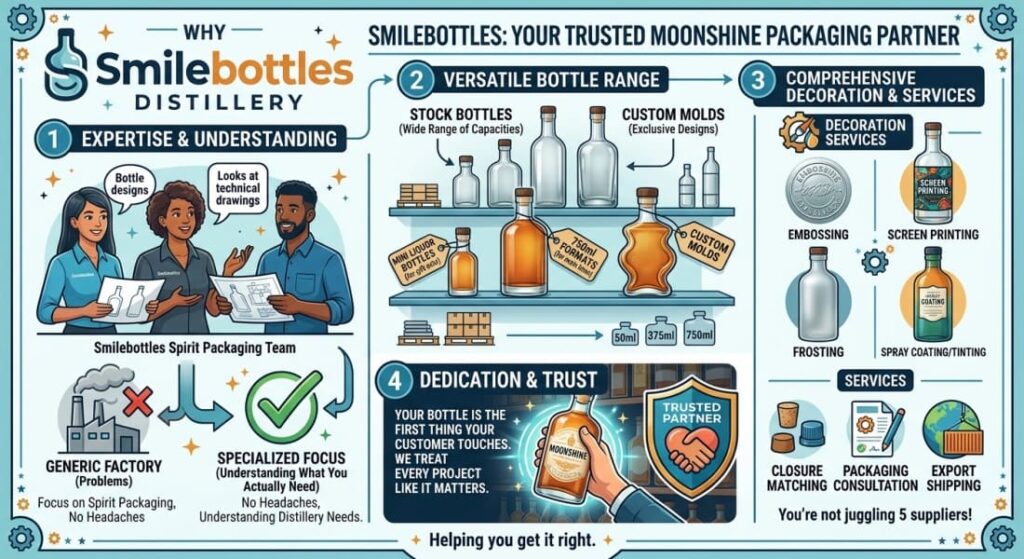
Years of experience in glass spirits bottles production means fewer surprises during development. A wide range of stock designs, from 50ml liquor bottles wholesale for miniatures to 750ml liquor bottles wholesale for standard retail, gives you flexibility to build a product line without hunting across suppliers.
Customization covers bottle shape, embossing, decoration, closure matching, and packaging. Quality control follows food-grade standards with documented inspection at multiple production stages. Export packaging is designed for long-distance shipping, with reinforced cartons and pallet configurations that minimize breakage.
The goal isn’t to sell you a bottle. It’s to help you build a product that sells itself.
FAQ: Frequently Asked Questions About Moonshine Bottles for Spirit Packaging
Q1:What is a moonshine bottle?
A1:A moonshine bottle is a glass container inspired by the traditional jars and jugs once used to hold homemade spirits. Modern versions keep the rustic look but are manufactured to full commercial standards.
Q2:Are moonshine bottles only used for moonshine spirits?
A2:No. They’re used for whiskey, rum, vodka, gin, tequila, liqueurs, flavored spirits, and even non-alcoholic craft beverages. The shape works anywhere heritage and craft messaging fits.
Q3:What sizes are available for moonshine bottles?
A3:Common sizes include 50ml, 100ml, 200ml, 375ml, 500ml, 700ml, 750ml, 1L, and 1.75L. Custom sizes are possible with a new mold.
Q4:Can moonshine bottles be customized with logos or embossing?
A4:Yes. Embossing requires a new mold, so it’s typically part of a custom bottle project. Logos can also be added through screen printing, ACL, hot stamping, and labeling.
Q5:What closure options work best for moonshine-style bottles?
A5:Bar-top T-corks, straight corks, screw caps, swing-tops, and tamper-evident closures all work well. Your choice depends on your brand positioning and your bottling line.
Q6:Are moonshine bottles suitable for premium spirit brands?
A6:Yes. With quality glass, thoughtful decoration, and the right closure, moonshine bottles support premium pricing very effectively.
Q7:Can Smilebottles handle custom mini liquor bottles wholesale projects?
A7:Yes. Small formats have their own technical considerations, and custom molds for miniatures are possible at appropriate volumes.
Conclusion
Moonshine bottles have moved a long way from their origins. What started as practical containers for backcountry distillers has become one of the most effective branding tools in modern glass spirit packaging. They combine heritage with function, aesthetics with market impact, and story with substance.
If you’re developing a new spirit brand, expanding a product line, or sourcing packaging for a private-label project, the moonshine bottle deserves serious consideration. It’s a shape that works across categories, communicates before your label does, and holds its own on any shelf in the world.
When you’re ready to talk specifics — sizes, molds, decoration, MOQs, or export logistics — Smilebottles is here to help you turn your packaging idea into something real, and something that sells.
 English