
Table of Contents
ToggleAuthor: SmileBottles Editorial Team
Estimated Reading Time: About 15 Minute
If you’ve ever stood in front of a shelf of mason jars and wondered which one to grab, you’re not alone. People ask about mason jar sizes for all kinds of reasons — canning tomatoes, packing lunch, sourcing packaging for a product line, or just figuring out how much a jar actually holds. The answer isn’t always as simple as picking up the nearest one.
Mason jars come in a range of sizes, typically from 4 oz all the way up to 64 oz. The most common ones you’ll run into are 8 oz, 16 oz, and 32 oz. But when you’re asking how big is a mason jar, the answer depends on more than just capacity. You also need to think about mouth diameter, overall height, body width, and how the jar will actually be used. This guide covers all of that — standard mason jar sizes, mouth types, dimensions, unit conversions, and what each size is genuinely best for.
Mason Jar Sizes at a Glance
The standard mason jar sizes cover a pretty wide range. Here’s a quick overview before we get into the specifics:
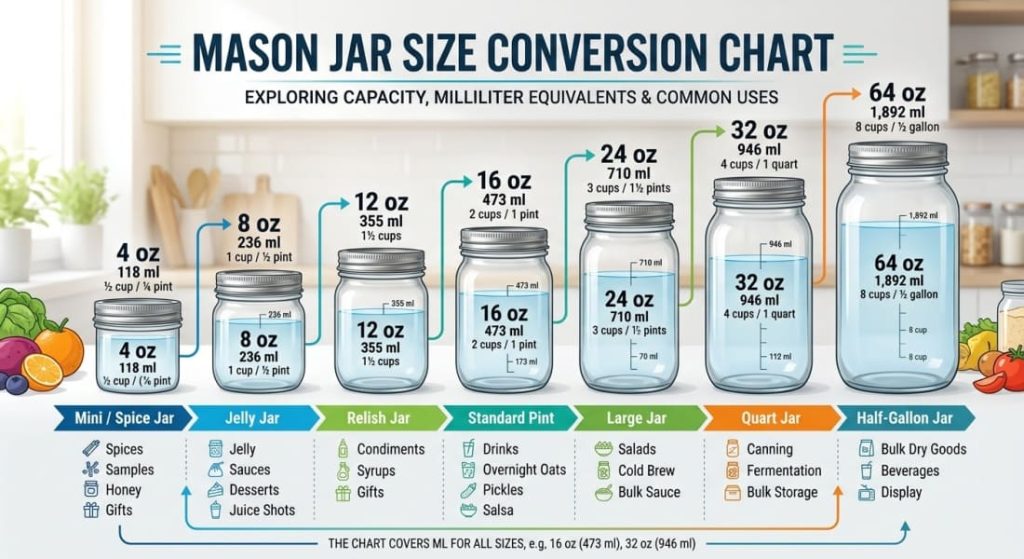
4 oz — small mason jar size, often used for spices, samples, or single-serve jams
8 oz — half-pint, one of the most versatile sizes for jelly, sauces, and desserts
12 oz — slightly larger than a half-pint, useful for condiments and specialty foods
16 oz — the pint jar, widely used for drinks, meal prep, and canning vegetables
24 oz — a useful mid-size for salads, cold brew, or bulk condiments
32 oz — the quart jar, a staple for canning, bulk storage, and fermentation
64 oz — the large mason jar size, sometimes called a half-gallon, suited for bulk or decorative use
Exact dimensions vary by manufacturer and jar style, which we’ll get into below. And whether a jar is regular mouth or wide mouth affects how practical it is for different tasks — more on that shortly.
Standard Mason Jar Capacities and Unit Conversions
One of the most common questions people have is how many ounces are in a mason jar, or how to convert between ounces, milliliters, and cups. The jar with measurements you’re looking for is really a matter of knowing the equivalents.
Common Mason Jar Sizes in Ounces
Here’s how each standard mason jar size relates to common volume units:
4 oz = quarter pint
8 oz = half pint
12 oz = three-quarter pint
16 oz = 1 pint
24 oz = 1.5 pints
32 oz = 1 quart
64 oz = half gallon
If you’re wondering how many ounces is a standard mason jar, the honest answer is that it depends on which size you’re referencing. The most commonly sold size — the pint — holds 16 oz. But a standard mason jar size for canning might be 32 oz, while someone buying small mason jar sizes for favors or samples would default to 4 oz or 8 oz.
Regular Mouth vs. Wide Mouth Mason Jars
Two jars can share the same capacity and look nearly identical on the outside, but have completely different mouth openings. This is one of the most practical distinctions when you’re choosing mason jars for canning, packaging, or everyday storage.
What Is a Regular Mouth Mason Jar?
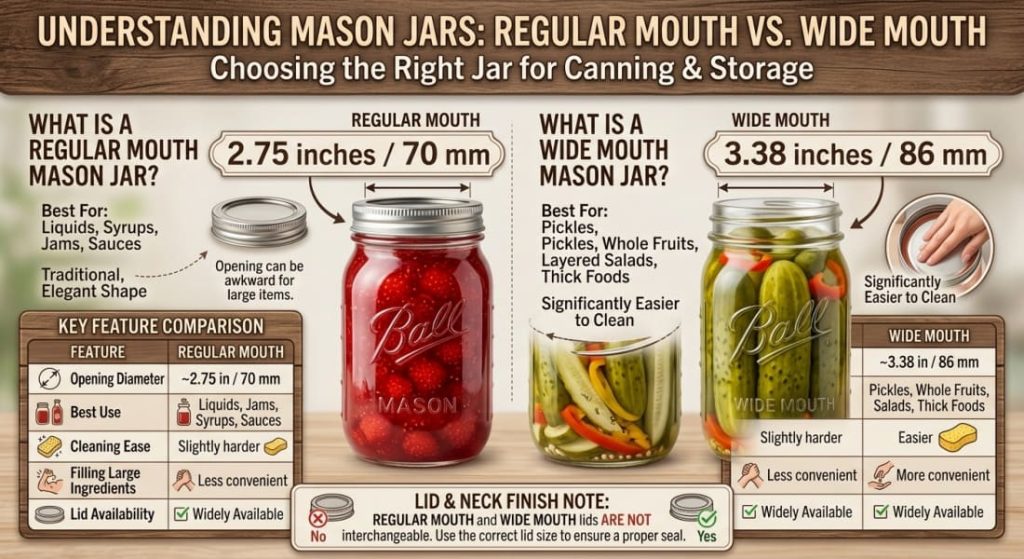
A regular mouth mason jar has an opening of approximately 2.75 inches / 70 mm. The narrower neck makes it better suited for liquids and pourable foods — things like jams, syrups, sauces, and salad dressings. The shape is more traditional and a bit more elegant-looking on a shelf.
The regular mouth mason jar opening size is smaller, which means filling it with large chunks or whole fruit can get awkward. But for anything you’re pouring in or out, it works well.
What Is a Wide Mouth Mason Jar?
The wide mouth mason jar has an opening of approximately 3.38 inches / 86 mm. The wide mouth mason jar diameter makes it easier to fill with large ingredients, whole fruits, pickles, or layered salads. It’s also significantly easier to clean by hand.
If you’re doing any kind of batch canning that involves packing whole vegetables or fruit, a wide mouth jar is usually the practical choice. The size of the wide mouth mason jar opening is also easier to work with when scooping out thick foods like nut butter or coconut oil.
Which Mouth Size Should You Choose?
Keep in mind that regular mouth lids and wide mouth mason jar sizes use different neck finishes. You cannot use a regular mouth lid on a wide mouth jar — the threads don’t match and the seal won’t hold.
Mason Jar Dimensions: Height, Diameter, and Overall Size
Beyond capacity, many buyers need to know the physical dimensions — mason jar height, body width, and overall footprint — before committing to a jar for packaging, canning lines, or custom labels.
Typical Dimensions by Jar Size
The figures below are approximate. Actual mason jar dimensions can vary between manufacturers, and even between product lines from the same manufacturer, depending on whether the jar is straight-sided, shouldered, or a decorative style.
|
Capacity |
Typical Height |
Typical Diameter |
Mouth Style Options |
|
4 oz |
~2.25–2.5 in (57–64 mm) |
~2.25–2.5 in (57–64 mm) |
Regular |
|
8 oz |
~4–4.25 in (102–108 mm) |
~2.75–3 in (70–76 mm) |
Regular / Wide |
|
16 oz |
~5–5.25 in (127–133 mm) |
~3–3.5 in (76–89 mm) |
Regular / Wide |
|
32 oz |
~6.75–7 in (171–178 mm) |
~3.5–4 in (89–102 mm) |
Regular / Wide |
|
64 oz |
~9–9.5 in (229–241 mm) |
~4–4.5 in (102–114 mm) |
Wide (typical) |
For 16 oz mason jar measurements specifically: you’re generally looking at around 5 to 5.25 inches tall with a body diameter between 3 and 3.5 inches. The 32 oz mason jar dimensions land around 6.75 to 7 inches tall. These are useful ballpark figures, but always verify specs with your supplier before finalizing label designs or production tooling.
Why Mason Jar Dimensions Can Vary
The volume of a mason jar tells you how much it holds, but not its exact shape. Several factors create variation in glass jar dimensions:
Jar style: Straight-sided jars and shouldered jars have different height-to-diameter ratios even at the same capacity
Brand and manufacturing design: Different manufacturers use slightly different molds
Decorative vs. standard: Embossed or decorative jars often have unique proportions
Closure style: Ball finish vs. lug finish vs. other neck styles can affect dimensions slightly
Manufacturing tolerances: Even within a product line, small dimensional variation is normal in glass production
If you’re planning a retail product or a canning line, always request exact mason jar specifications from your supplier before proceeding with label sizing or equipment setup.
What Size Mason Jar Do You Need?
Once you know the available mason jar sizes and dimensions, the next question is practical: which size actually fits your needs? Here’s a breakdown by use case.
Best Mason Jar Sizes for Canning
Canning is probably the most classic use for mason jars, and the right jar size depends on what you’re preserving and how much you want in each batch.
4 oz: Perfect for jellies, hot sauce samples, or small-batch preserves
8 oz: The go-to for jams, chutneys, and most fruit spreads — jam jar dimensions at this size are compact and easy to gift
16 oz: Works well for salsa, pickles, sliced vegetables, and fruits
32 oz: Best for large-batch canning — tomatoes, broth, beans, and whole vegetables
For anyone asking what size are canning jars in general, the pint (16 oz) and quart (32 oz) are the two most common canning jar sizes.
Best Mason Jar Sizes for Drinks and Meal Prep
Mason jars have become a go-to container for beverages and on-the-go food. Here’s what works:
8 oz: Juice shots, smoothie shots, small desserts
16 oz: Smoothies, overnight oats, iced coffee, infused water — this is the most popular size for meal prep
24 oz / 32 oz: Mason jar salads, cold brew concentrate, large drinks
If you’re making overnight oats, the 16 oz mason jar is typically the best mason jar size for overnight oats — it holds a full serving with a little room at the top.
Best Sizes for Pantry and Dry Storage
Mason jars are excellent for pantry organization, especially for bulk dry goods.
16 oz: Good for nuts, seeds, dried herbs, and small grains
32 oz: Handles pasta, flour, rice, and beans well
64 oz: The largest mason jar size that’s practical for kitchen storage — good for bulk items like coffee, oats, or cereals
Best Sizes for Gifts, Events, and Retail Packaging
If you’re packaging a product for retail or putting together gift sets, the smaller sizes tend to perform better.
4 oz / 8 oz: Candles, bath salts, honey, gift jams — these are easy to handle and cost-effective for sampling
12 oz / 16 oz: Branded sauces, specialty products, premium gifts
Custom mason jar sizes are available through manufacturers like Smilebottles for private label or OEM production
Mason Jar Size Chart: Capacity, Height, Mouth Size, and Common Uses
Here’s a single master reference table covering the key dimensions and uses across all standard mason jar sizes. Use this as your go-to quick reference when comparing sizes mason jars.
Note: All measurements are approximate. Dimensions vary across manufacturers, jar styles, and product lines. Confirm specifications with your supplier for production or labeling purposes.
Popular Uses for Mason Jars Beyond Canning
Mason jars aren’t just for canning anymore. The various sizes of mason jars have found their way into almost every corner of daily life and commercial packaging.
Food Storage and Kitchen Organization
The airtight seal and clear glass make mason jars a natural fit for pantry organization. Seeing exactly what’s inside without opening each container saves time, and glass doesn’t absorb odors the way plastic sometimes does.
Beverage Packaging
Mason jars have become a popular container for kombucha, cold brew, infused water, and specialty drinks. The different sizes of mason jars give producers flexibility — smaller jars for single-serve products, larger ones for concentrates or multi-serve sizes.
Candles and Home Fragrance
The glass jar dimensions that make mason jars practical for food also make them ideal for candle pouring. Consistent wall thickness, good thermal resistance, and a clean aesthetic work well for home fragrance brands. The 8 oz and 16 oz jars are especially popular in this category.
DIY Gifts and Event Favors
Small mason jar sizes — particularly 4 oz and 8 oz — are popular for wedding favors, holiday gifts, and branded giveaways. The jar itself serves as part of the presentation.
Cosmetic and Wellness Packaging
Food-grade glass jars are used widely for natural beauty products: scrubs, lotions, bath salts, and balms. Customers in this space often prefer glass over plastic for perceived quality and sustainability.
Décor and Home Organization
Beyond function, mason jars have a permanent place in home décor — used as vases, organizers, and decorative containers. The classic shape and various sizes of mason jars make them easy to incorporate into almost any style.
Size Isn’t Everything: How to Choose a Quality Mason Jar
Knowing how many ounces does a mason jar hold is a good start, but when you’re sourcing jars — especially in volume — there are other factors that matter just as much.
Glass Quality and Durability
Not all glass is created equal. For food contact applications, you want food-grade glass with consistent clarity and no visible bubbles, striations, or inclusions. Wall thickness affects both weight and thermal resistance. A jar used for hot-fill canning needs to handle temperature transitions without cracking; one used for dry storage or candles may have more flexibility.
Closure Compatibility
Mason jar lid dimensions and neck finish need to match. A jar with a 70 mm regular mouth finish takes a different lid than a wide mouth jar with an 86 mm finish. If you’re mixing jars from different manufacturers or switching styles mid-production, always verify that the closure is compatible before running a batch.
The mason jar lid size also affects how the finished product looks on a shelf or in a gift set, so it’s worth getting lid specifications right early.
Intended Use
The same jar shape can perform very differently depending on how it’s being used:
Hot-fill canning requires jars rated for high-temperature processing and adequate sealing reliability
Cold storage and dry goods have more tolerance in glass spec but still benefit from consistent wall thickness
Retail display often prioritizes clarity and clean lines over raw durability
Gifting and events may prioritize aesthetics and label area
Design and Branding Options
If you’re sourcing mason jars for a brand, the visual details matter. Custom options might include:
Embossed logos or text on the glass
Clear vs. frosted finish
Custom label panel areas
Non-standard shapes or proportions
Colored or tinted glass
Bulk Sourcing and Manufacturing Consistency
When you’re ordering at volume, dimensional consistency becomes critical. Small variations in mason jar diameter or mason jar height can cause problems on automated lines or when applying labels. Working with a manufacturer who maintains tight tolerances and reliable quality inspection reduces headaches downstream.
Other practical considerations for bulk orders:
Minimum order quantities (MOQ)
Lead times
Packaging for transit (how jars are packed to avoid breakage)
Quality documentation
Custom Mason Jar Options from Smilebottles
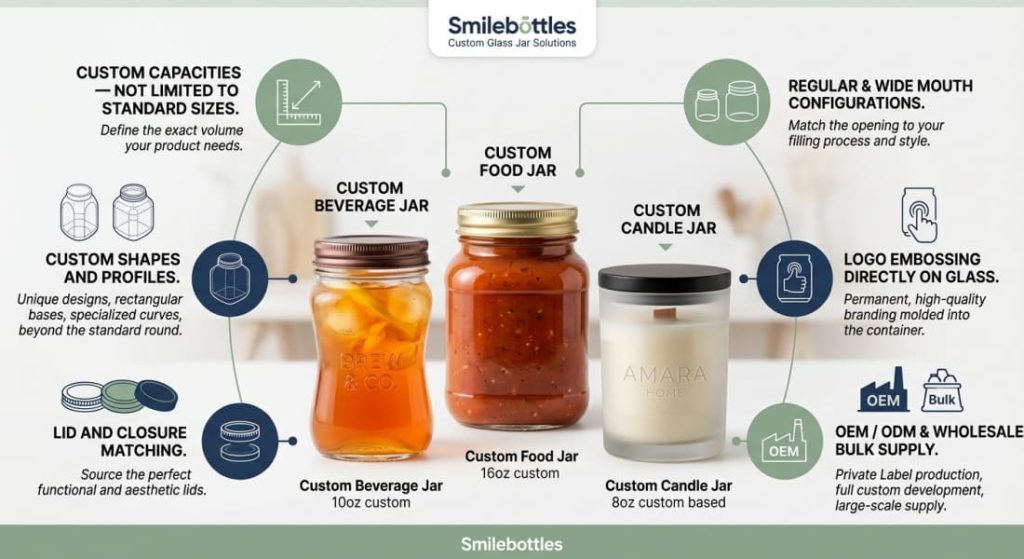
For brands that need something beyond standard mason jar sizes, custom glass jar solutions are available through Smilebottles. Whether you’re developing a new food product, launching a candle line, or building a private-label brand, getting the jar dimensions and specifications right from the start saves time and money later.
Smilebottles works with clients on:
Custom capacities — not limited to standard sizes
Regular mouth and wide mouth configurations
Custom shapes and profiles
Logo embossing directly on the glass
Lid and closure matching
Private label, OEM, and ODM production
Wholesale and bulk glass jar supply
Quality inspection and documentation support
For brands that need more than standard mason jar sizes, Smilebottles provides custom glass jar solutions tailored to food, beverage, home fragrance, and gift packaging applications.
The goal is to help you find or build a jar that actually works for your product — not just a container that technically fits the volume.
FAQ: Frequently Asked Questions About Mason Jar Sizes
Q1:What are the standard mason jar sizes?
A1:The most common mason jar sizes are 4 oz, 8 oz, 12 oz, 16 oz, 24 oz, 32 oz, and 64 oz. Each size is available in regular mouth or wide mouth styles, with dimensions varying slightly by manufacturer and jar design.
Q2:What is the difference between pint and quart mason jars?
A2:A pint mason jar holds 16 oz (473 ml); a quart mason jar holds 32 oz (946 ml). The quart jar is roughly twice the capacity and noticeably taller and wider. For canning, the quart size is typically used for vegetables and tomatoes, while the pint is more common for jams and pickles.
Q3:Are mason jar dimensions universal?
A3:No. Mason jar specifications vary between manufacturers, jar styles, and product lines. While the opening sizes for regular mouth (approximately 70 mm) and wide mouth (approximately 86 mm) follow widely-used standards, height and body diameter can differ meaningfully across brands. Always confirm dimensions directly with your supplier.
Q4:What is the opening size of a regular mouth mason jar?
A4:The regular mouth mason jar opening size is approximately 2.75 inches / 70 mm. This is the standard neck finish for regular mouth jars.
Q5:What is the opening size of a wide mouth mason jar?
A5:The wide mouth mason jar diameter at the opening is approximately 3.38 inches / 86 mm, making it noticeably easier to fill and clean than a regular mouth jar.
Q6:Which mason jar size is best for overnight oats?
A6:The 16 oz pint jar is the most popular choice for overnight oats. It holds a full serving with a little room to stir, fits easily in a refrigerator, and the wide mouth version makes it simpler to eat straight from the jar.
Q7:What is the biggest mason jar size?
A7:The largest commercially available mason jar size is typically 64 oz (half-gallon). Some specialty glass jar manufacturers offer larger custom sizes, but 64 oz represents the top of what’s generally available as a standard product.
Q8:How much does a mason jar weigh?
A8:The weight of a mason jar varies by size and glass thickness. A standard 16 oz mason jar typically weighs between 0.5 and 0.75 lbs empty. Larger and heavier-walled jars will weigh more. If you need exact weight for shipping calculations or product listings, request the specifications from your supplier.
Conclusion
Mason jar sizes aren’t complicated once you know what you’re looking at — but there are more variables than most people expect. Capacity, mouth size, height, diameter, and glass quality all play a role in whether a jar actually works for what you need it to do.
If you’re canning, the pint and quart sizes cover most situations. For drinks and meal prep, the 16 oz jar is hard to beat. For retail packaging or gifting, smaller sizes in the 4 oz to 8 oz range tend to work best. And when standard sizes don’t quite fit your product, custom glass jar solutions give you the flexibility to get the specifications right.
Understanding the full picture — not just how many ounces in a mason jar, but also dimensions, mouth size, and glass quality — puts you in a much better position to source the right jar the first time. If you have questions about a specific size or need help with custom mason jar specifications, the team at Smilebottles is glad to help.
 English