
Table of Contents
ToggleAuthor: SmileBottles Editorial Team
Estimated Reading Time: About 15 Minute
The safest way to choose a bottle is to start with the medicine, not the packaging catalogue. That sounds obvious, yet many projects begin with a photo, a preferred shape, or a request for “a standard 100 mL bottle.” The problems usually appear later: the label does not fit, the cap is hard to source, the bottle wobbles on the filling line, or the finished pack does not give the formula enough protection.
Your bottle has several jobs. It must hold the correct fill volume, protect the formula, close reliably, work with a dosing device, and travel without excessive breakage. It also has to suit the rules and buying habits of the market where the medicine will be sold. In other words, you are not choosing one glass component. You are choosing a complete packaging system.
This article walks through the glass bottle shapes and sizes you are most likely to meet, then looks at color, closures, customization, and the checks worth making before you order.
Why Glass Is Still Widely Used for Liquid Medicine
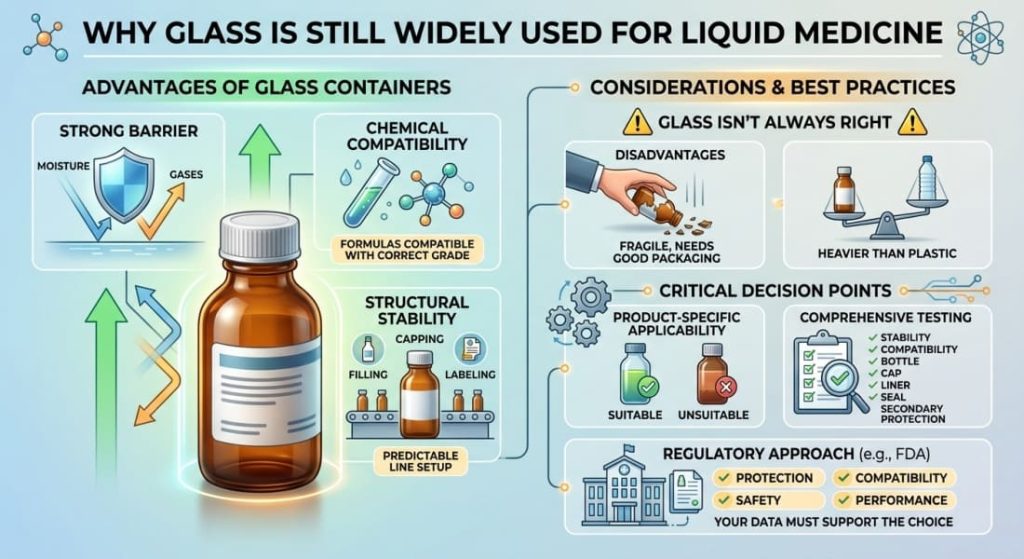
Glass remains common because it provides a strong barrier. Moisture and gases do not readily pass through the bottle wall, and many liquid formulas are compatible with the right grade of glass. A glass medicine bottle also keeps its shape during filling, capping, labeling, and storage, which can make line setup more predictable.
That does not mean glass is automatically right for every product. It is heavier than plastic and can break if the shipping pack is poorly designed. More importantly, the same bottle may be suitable for one formula and unsuitable for another. Your stability and compatibility work needs to cover the bottle, cap, liner, seal, and any secondary protection that forms part of the final pack.
The US Food and Drug Administration treats protection, compatibility, safety, and performance as product-specific questions. That is a useful way to approach the project even if you sell outside the United States. A familiar bottle shape is only a starting point; your own product data must support the final choice.
The Main Bottle Shapes You Will Come Across For Liquor Medicine
Most oral liquids do not need an unusual container. A proven standard shape is often easier to source, easier to match with closures, and faster to approve. Still, the names used in catalogues can be loose. Always place the supplier’s drawing beside the name before you compare quotations.
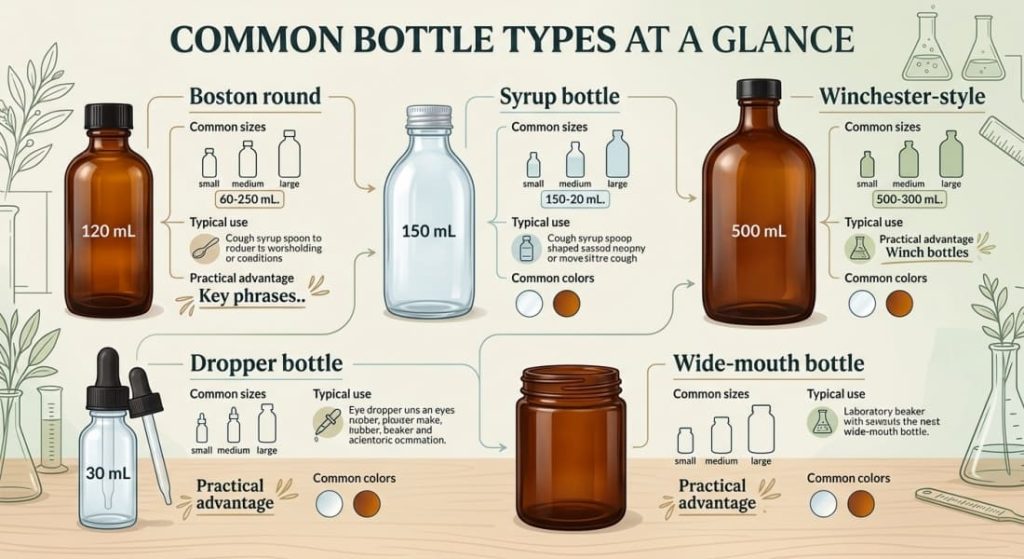
Syrup bottles
Traditional syrup bottles normally have a round body, a short neck, and shoulders that allow the liquid to pour without running down the outside too easily. They are widely used for cough preparations, pediatric syrups, herbal liquids, and tonics. You will commonly find them between 60 mL and 250 mL.
For a retail cough syrup bottle, look beyond the body shape. Does the neck accept the cap and liner you plan to use? Will a dosing cup sit over the closure? Is the bottle comfortable to hold when it is full? A 200 mL bottle may look compact when empty but feel quite different once it contains a dense syrup.
Boston round bottles
You can recognize boston round bottles by their rounded shoulders, narrow neck, and straight cylindrical body. They are common in amber glass, though clear versions are easy to find. The shape provides a useful label panel and works with many screw caps, dropper assemblies, and small-volume dispensing systems.
There is one catch: “Boston round” describes a shape, not a pharmaceutical standard. General-purpose bottles can look almost identical to bottles made under tighter controls. Ask for the glass specification, finish drawing, capacity tolerance, dimensions, and quality documents before you treat a sample as production-ready.
Winchester-style bottles
Winchester-style bottles have a traditional pharmacy or laboratory look and are often used for larger volumes. The name is not applied consistently in every country. If you ask for a Winchester bottle, add the nominal volume, brimful capacity, neck finish, color, and intended use. Otherwise, two suppliers may quote two quite different containers under the same name.
Dropper and small-dose bottles
Dropper bottles are useful for pediatric drops, concentrated liquids, and products taken in small quantities. Typical sizes include 10 mL, 15 mL, 30 mL, and 50 mL. Here, the dispensing part deserves as much attention as the glass.
A dropper does not always deliver the same amount with every liquid. Viscosity, surface tension, holding angle, and the way a user squeezes the bulb can all change the result. Test the actual formula with the intended dropper or insert rather than assuming that a component sold as “1 mL” will give the right dose under all conditions.
Wide-mouth bottles and other special shapes
A wide opening can help with a thick product or a filling process that is awkward through a narrow neck. For most free-flowing oral liquids, however, it brings more disadvantages than benefits. Pouring becomes harder to control, spills are more likely, and your closure choices may narrow.
Custom ovals, rectangular bottles, and flasks can give you a distinctive pack or better shelf use. They can also need dedicated line parts and more complicated case packing. Unless the shape solves a real problem, a standard round bottle is usually the simpler place to begin.
Common Bottle Types Of Medicine Glass Bottles at a Glance
Bottle type | Common sizes | Typical use | Practical advantage | Common colors |
Syrup bottle | 60-250 mL | Cough syrup, pediatric syrup, tonic | Familiar shape and controlled pouring | Amber, clear |
Boston round | 15-500 mL | Oral liquids, drops, herbal products | Good label area and many closure options | Amber, clear |
Winchester-style | 250 mL and above | Clinic, laboratory, compounding | Suitable for larger-volume formats | Amber, clear |
Dropper bottle | 10-50 mL | Concentrated liquids and oral drops | Better control at low doses | Amber, clear |
Wide-mouth bottle | Project-specific | Thick or process-sensitive products | Easier access during filling | Amber, clear |
The table is useful for narrowing the choice, but it cannot replace samples and a technical drawing. Even two 100 mL bottles can differ in brimful capacity, finish, weight, and label height.
What the Common Sizes Are Actually Used For liquid medicine bottle
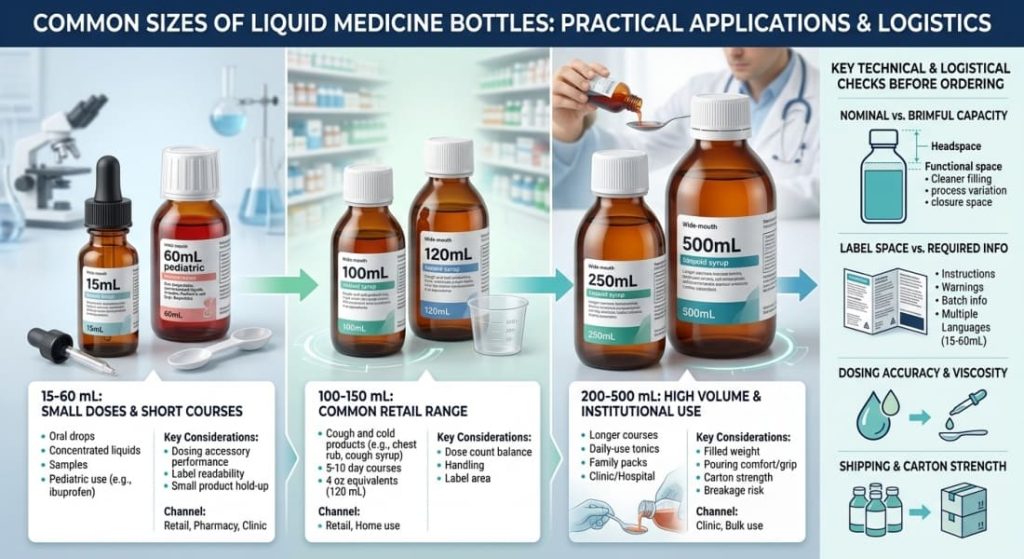
When people discuss liquid medicine bottle sizes, they often mix up nominal capacity and brimful capacity. Nominal capacity is the volume you intend to fill and state on the label. Brimful capacity is what the bottle holds when filled to the very top. The gap between the two provides headspace.
That headspace is not wasted room. It helps the filler work cleanly, allows for normal process variation, and leaves space under the closure. The right amount depends on the formula, fill temperature, foaming, and filling method.
Nominal size | Where it is often used | Point to check before ordering | Typical channel |
15-30 mL | Drops and concentrated liquids | Dropper performance and label readability | Retail, clinic |
60 mL | Short courses and pediatric liquids | Dosing accessory and closure choice | Retail, pharmacy |
100-120 mL | Cough and cold products | Dose count, label area, and headspace | Retail, home use |
150-200 mL | Longer courses and daily-use tonics | Filled weight and pouring comfort | Retail, clinic |
250-500 mL | Family, clinic, or institutional use | Handling, carton strength, and breakage | Clinic, bulk use |
15 mL to 60 mL: small doses and short courses
Small bottles suit oral drops, concentrated formulas, samples, and short treatment periods. A 60ml medicine bottle is large enough for many pediatric or short-course products but still easy to hold. The trade-off is label space. Once you add directions, warnings, batch information, and more than one language, you may need a carton or leaflet.
Pay close attention to the product left behind after use. With a very small fill, a little liquid trapped around the shoulder or beneath an insert can represent a meaningful part of the total volume.
100 mL to 150 mL: the common retail range
A 100ml medicine bottle is popular because it balances dose count, handling, and label area. It is not automatically the best option, though. Work backward from the dose. If a patient takes 10 mL twice a day for five days, the planned course uses 100 mL. Your technical team can then decide whether the approved filling process needs an allowance beyond that amount.
Markets that use fluid ounces may favor 120 mL because four US fluid ounces is about 118.3 mL. Make sure the declared volume, filling target, and any molded graduations tell the same story.
200 mL to 500 mL: more product, more handling risk
Larger bottles may reduce packaging cost per milliliter, but they are heavier and less comfortable to pour. Try the filled pack with the people who are likely to use it. A caregiver measuring several small doses may prefer a bottle with a secure grip and a clean lip over one that simply looks substantial on the shelf.
An 8 oz syrup bottle is another term that needs clarification. Eight US fluid ounces is about 236.6 mL. Some catalogues use 240 mL, while others group 250 mL into the same commercial category. Put the exact nominal and brimful volumes on the request for quotation.
Choosing the Size: A Practical Way to Work It Out
Start with the dose and treatment period. Multiply the volume per dose by the number of daily doses and the number of days. Then discuss overfill, product residue, and filling tolerance with the relevant technical team. This gives you a rational target instead of a bottle chosen mainly for its proportions.
Watch out for mixed search results. Searches for pill bottle sizes usually lead to dry-dose pharmacy vials, which have different moisture, closure, and dispensing needs from liquid medicine bottles. In the same way, a prescription bottle may mean a pack filled by a pharmacy rather than a sealed retail bottle filled by the medicine manufacturer. State who fills the package and how it reaches the user.
Once you have a target volume, look at the whole supply chain. A taller bottle may fit the label beautifully but waste space in the shipper. A short, wide bottle may pack well but need new conveyor guides. A glass bottle that stands perfectly during hand filling may begin to wobble when the line runs at full speed.
It is worth making a simple cost comparison at this stage. Include the bottle, cap, liner, seal, label, carton, pallet use, freight, and expected breakage. The cheapest empty bottle is not always the lowest-cost finished pack.
Amber or Clear Glass for Liquid Medicine?
When amber glass makes sense
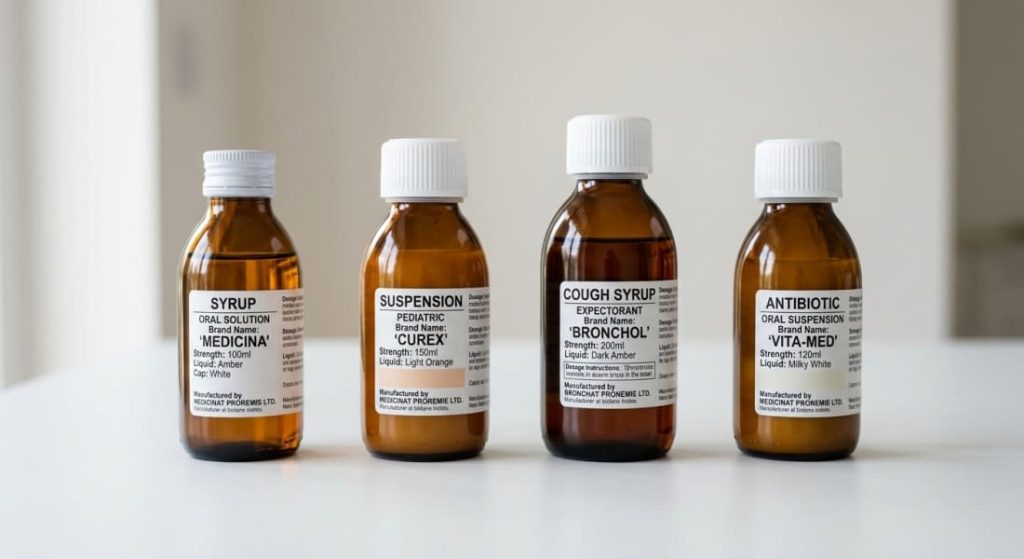
You will often see amber glass medicine bottles used for formulas that need protection from light. Amber glass can reduce transmission across parts of the ultraviolet and visible spectrum, but color alone is not proof that the package offers enough protection.
Ask for the color specification and any available transmission data, then include the production-intent pack in stability work. Shade can vary between batches, so agree on an acceptable range if appearance matters to the brand.
When clear glass is useful
With clear glass medicine bottles, you can see the product, the fill level, and any visible changes. That can help inspection and can suit a formula that is not light-sensitive. The decision still belongs in the product’s stability and regulatory assessment.
Clear glass also makes cosmetic differences easier to notice. Small seeds, scuffs, or variations in the liquid may be more obvious than they would be in amber glass. Agree on visual standards with real samples rather than relying on a clean catalogue photograph.
Green glass, frosting, and sprayed colors are available for special product lines, but decorative opacity is not the same as pharmaceutical light protection. An opaque water bottle is a consumer description, not a useful specification for medicine packaging. Define the protection you need and test the proposed pack.
The Closure Can Make or Break the Project
It is tempting to approve the bottle first and deal with the cap later. That order causes trouble surprisingly often. The finish may not have a suitable child-resistant closure, the liner may react with the formula, or the dosing cup may not fit over the cap.
For a continuous-thread screw cap, obtain the full finish drawing. Diameter by itself is not enough. During the line trial, check application torque, removal torque, leakage, and the condition of the thread and liner. Too little torque may leave a weak seal; too much can make the pack hard to open or damage the components.
Child-resistant packaging is required for certain medicines and markets. In the United States, the Poison Prevention Packaging Act covers many substances and prescription drugs, with specific exceptions. Use the rule that applies to your product and ask for evidence covering the actual bottle-and-closure combination. A “push and turn” description in a catalogue is not the same as tested compliance.
Tamper evidence is a separate issue. Breakaway bands, shrink sleeves, film wrappers, and induction seals can all provide visible evidence of opening when they are properly designed. Most US over-the-counter medicines need a tamper-resistant feature and related labeling, subject to stated exceptions. The choice affects the line: an induction seal needs compatible materials and equipment settings, while a shrink band changes the space needed in the carton.
Do not leave the dosing device until the end either. Check that cup markings are easy to read and include the needed dose. With droppers or syringe adapters, test the actual liquid. A device that works with water can behave differently with a thick syrup.
What Belongs in the Bottle Specification
When you buy pharmaceutical glass bottles, a sample and an email description are not enough for repeat orders. Use a controlled drawing and specification. At a minimum, record:
- nominal and brimful capacity;
- glass type, color, and any surface treatment;
- bottle weight and key dimensional tolerances;
- full neck-finish details and sealing-surface requirements;
- label panel, embossing, and decoration area;
- agreed visual defect limits or reference samples;
- carton, pallet, and export packing configuration;
- documents, sampling plans, and tests required with each batch.
The closure specification should be linked to the bottle rather than kept as an unrelated purchasing item. Record the cap material, liner, torque range, seal, tamper-evident feature, and any child-resistant qualification that applies.
Custom Bottles: When They Are Worth the Extra Work
A custom mold makes sense when it solves a real need: a more stable base, a better grip, a larger label panel, a unique dosing feature, or a shape central to the brand. It is harder to justify when the only goal is to look slightly different from a standard bottle.
Before paying for tooling, compare the expected annual volume with mold cost, minimum order, development time, and spare-mold planning. Check the design on the filling, capping, labeling, and cartoning equipment before the final mold is approved.
Embossing can add permanent brand identification, but fine lettering often looks clearer in a computer drawing than it does in production glass. Keep raised details away from the sealing area and leave a smooth panel for the label. If you add printed decoration, frosting, or coating, test it against rubbing, condensation, product drips, and carton contact.
Why Choosing Smilebottles As a Manufacturer For Glass Bottle Of Liquor Medicine?
A useful supplier does more than send prices. You need clear drawings, consistent samples, sensible closure support, and honest feedback when a requested design will be difficult to make or pack. Ask which oral liquid bottles are already in regular production and which markets the supplier commonly serves.
Review batch traceability, inspection methods, change control, minimum order quantities, lead times, and export packing. If a certification matters to your project, verify its current scope instead of relying on a logo in a brochure.
When you approach Smilebottles, share the nominal fill, formula category, color, finish, closure, dosing accessory, annual quantity, destination, and filling-line details. For a standard bottle, request the current drawing and representative samples. For a custom project, agree on mold responsibility, sample stages, approval points, decoration standards, and mass-production tolerances before tooling begins.
FAQ Frequently Asked Questions About Glass Liquor Medicine Bottles
Q1:Which glass bottle is best for liquid medicine?
A1:There is no single best shape. Your formula, dose, light sensitivity, closure, line, market, and shipping conditions determine the answer. Amber syrup bottles and Boston rounds are common because they are familiar and easy to source, but they still need to be qualified with the complete closure system.
Q2:Which sizes are most common?
Q2:You will often find 30 mL, 60 mL, 100 mL, 120 mL, 150 mL, 200 mL, and 250 mL. Choose the size from the dose and treatment period, then compare nominal capacity, brimful capacity, headspace, label area, and filled weight.
Q3:Is glass better than plastic?
A3:Not in every case. Glass offers a strong barrier and keeps its shape, but it is heavier and breakable. Plastic is lighter and more resistant to impact, though it brings different barrier and compatibility questions. Compare both with the actual formula and supply chain.
Q4:Can the bottle be customized?
A4:Yes. Shape, embossing, label panel, printing, coating, and packing can often be changed. Whether customization makes business sense depends on volume, tooling cost, technical risk, and the time available for testing.
Conclusion
The right bottle is rarely the one that wins on appearance alone. It is the one that holds the planned dose, gives the formula the protection it needs, accepts a proven closure, runs smoothly on the line, fits the label, and reaches the customer intact. Start with the product requirements, narrow the choice to a few realistic bottle families, and test production-intent samples. If you keep the bottle, closure, dosing device, label, and shipping pack in the same conversation from the beginning, you will avoid most of the expensive surprises that appear late in a packaging project.
 English