
Table of Contents
ToggleAuthor: SmileBottles Editorial Team
Estimated Reading Time: About 15 Minute
If you have ever opened a shipment of glass bottles and found unexplained cracks, or watched your filling line struggle with sudden breakage, you probably asked yourself the same question every buyer eventually asks: “Why did this happen? The bottles looked perfectly fine when they arrived.”
Most of the time, the answer is hiding inside the glass itself. It is not the color, not the shape, and not even the wall thickness you can measure with a caliper. The real reason is something called thermal stress, and the way to prevent it is a process called annealing in glass.
If you are buying glass packaging for food, beverage, cosmetic, perfume, essential oil, or pharmaceutical products, understanding these two topics will change the way you talk to your glass bottle supplier and the way you judge quality. In this guide, you will learn what thermal stress really means, how it forms during the glass bottle production process, why annealing matters so much, and what you should expect from a serious glass packaging manufacturer.
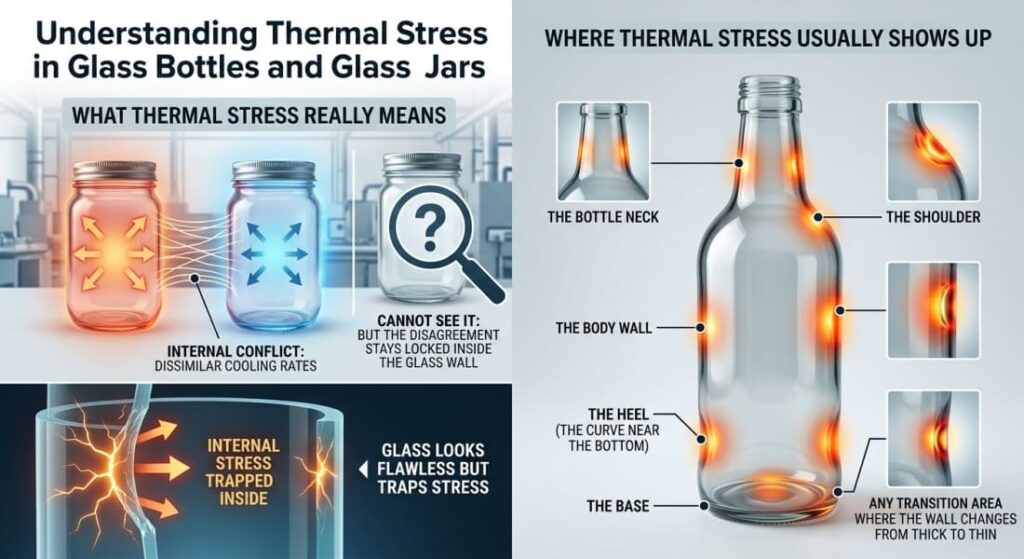
Understanding Thermal Stress in Glass Bottles and Glass Jars
Thermal stress sounds technical, but the idea behind it is simple once you break it down.
What Thermal Stress Really Means
Thermal stress is internal stress trapped inside a glass container because different parts of the bottle cooled at different speeds during production. Some areas want to shrink while others have already hardened, and that internal disagreement stays locked inside the glass wall.
You cannot see it with your eyes. The bottle can look flawless on the shelf and still fail the moment it meets hot product, cold storage, or a bump on a conveyor.
Why Glass Reacts So Strongly to Temperature Changes
Glass expands when it heats up and contracts when it cools. Unlike plastic, it does not flex or forgive. When one part cools faster than another, stress builds up almost instantly. And once that stress is inside the glass, it does not disappear on its own. It sits there quietly, waiting for the wrong moment.
Where Thermal Stress Usually Shows Up
Thermal stress rarely spreads evenly across the entire container. It tends to concentrate in specific weak points, including:
The bottle neck
The shoulder
The body wall
The heel (the curve near the bottom)
The base
Any transition area where the wall changes from thick to thin
If your design has a heavy base or a sharp shoulder, these are the areas your factory should watch carefully.
How Thermal Stress Forms During Glass Container Manufacturing
To understand why annealing matters, you first need to see how stress appears in the first place.
The High-Temperature Forming Stage
Glass containers are shaped at very high temperatures. A gob of molten glass falls into a mold, and the bottle takes shape through either blow-and-blow or press-and-blow forming. At this point, the glass is soft and glowing. Once it leaves the mold, the temperature starts to drop fast.
Uneven Cooling After the Bottle Is Formed
Here is where the trouble starts. The outer surface of the bottle touches the mold and cools quickly. The inside stays hot longer. When the inner part finally cools, it wants to shrink, but the outer layer is already solid and will not let it. That internal push-and-pull becomes stress locked inside the glass.
Design and Thickness Variations
Some designs invite more stress than others. Uneven wall thickness, heavy bases, sharp structural transitions, and complex custom shapes all create hot spots and cold spots during cooling. This is one reason why working closely with an experienced glass bottle manufacturer during the design stage really pays off. A good factory will tell you honestly which shapes are safe and which shapes need adjustment.
Process Instability
Even a great design can suffer if production is unstable. Inconsistent machine settings, improper conveyor speed, poor temperature control, or small fluctuations during a long production run can all leave behind stress that a well-tuned factory would have avoided.
How Thermal Stress Affects Glass Packaging Performance
You might wonder, “Does a little bit of internal stress really matter?” Honestly, it matters more than most buyers realize.
Reduced Mechanical Strength
Stress weakens the bottle from the inside. A container that should easily survive normal handling may crack under a small impact. On a high-speed filling line, this is a serious problem.
Higher Breakage During Shipping
Long-distance shipping is not gentle. Containers get shaken, stacked, and moved through changing temperatures. Bottles carrying residual stress cannot handle that extra load, and breakage rates climb.
Failure During Hot Filling or Sterilization
If you are producing sauces, jams, juices, or any product that requires hot fill glass bottles, this is where thermal stress becomes really dangerous. A poorly annealed bottle may look perfect at room temperature but crack the moment hot product hits the wall. The same applies to pasteurization and sterilization.
Thermal Shock Sensitivity
Thermal shock happens when the temperature changes suddenly, for example when a cool bottle meets hot liquid, or when a warm jar goes into cold storage. Stressed glass reacts poorly to these changes, and cracks appear where the internal stress was highest.
Product Loss and Customer Complaints
At the end of the day, thermal stress is not a laboratory topic. It becomes lost product, leaking cases, angry customers, returned shipments, and damage to your brand. That is why every buyer should understand this topic, not just the engineering team at the factory.
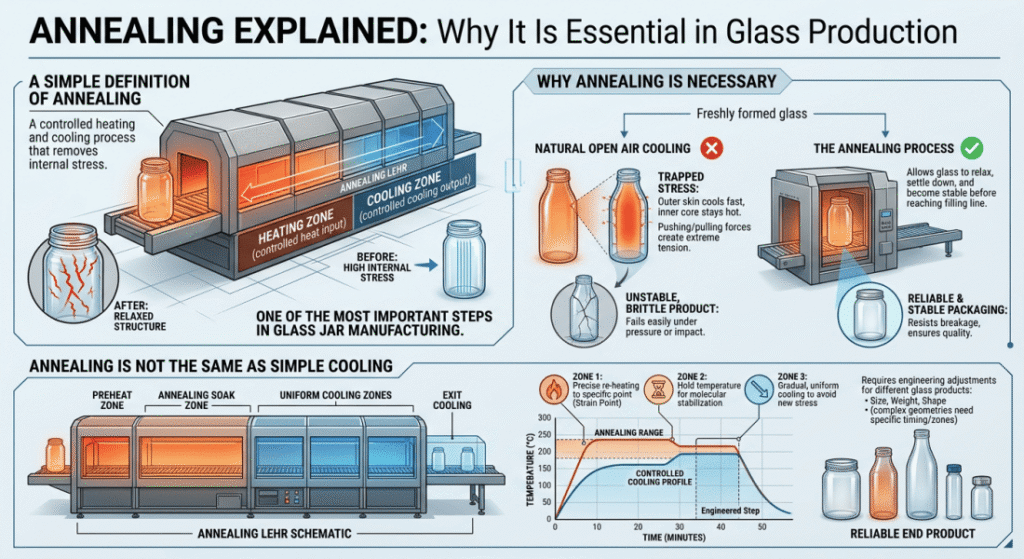
Annealing Explained: Why It Is Essential in Glass Production
Now that you understand how stress forms, let’s talk about how the industry removes it.
A Simple Definition of Annealing
Annealing in glass manufacturing is a controlled heating and cooling process that removes or greatly reduces internal stress inside newly formed glass containers. It is one of the most important steps in the entire glass jar manufacturing process.
Why Annealing Is Necessary
Freshly formed glass cannot simply cool naturally in open air. If it does, all the stress created during forming stays inside the wall for the life of the bottle. Annealing gives the glass a chance to relax, settle down, and become stable before it ever reaches your filling line.
Annealing Is Not the Same as Simple Cooling
Some buyers think annealing is just “letting the bottle cool slowly.” It is much more than that. Annealing is a carefully engineered step with specific temperature zones, precise timing, and adjustments based on the size, weight, and shape of every product. Skip it, and you skip the reliability of your packaging.
How Annealing Works in Glass Bottle and Jar Production
Here is a plain-language walkthrough of what actually happens inside a professional glass factory.
Step 1: The Bottles Enter the Glass Annealing Lehr
Right after forming, containers move into a long tunnel-shaped oven called a glass annealing lehr. The bottles enter while they are still very hot. Every detail inside the lehr is carefully controlled.
Step 2: Soaking at the Proper Temperature
The bottles are brought to a specific temperature and held there for a set time. This is the stress-relief zone. The glass is still solid, but it is soft enough for internal stress to loosen and release. The soaking time depends on the wall thickness and the design of the container.
Step 3: Slow and Even Cooling
After the soaking stage, the temperature drops slowly and evenly. If the cooling is too fast or uneven, new stress will form and the earlier work will be wasted. This is why the cooling curve inside the lehr matters so much.
Step 4: Parameter Adjustment by Product Type
A small perfume bottle, a heavy sauce jar, and a tall beverage bottle each need different annealing settings. A skilled glass jar manufacturer does not use one universal setting for everything. Parameters are adjusted for each product family, and this is where experience really counts.
Benefits of Proper Annealing for Glass Packaging Quality
When annealing is done well, you feel the difference across your entire supply chain.
Bottles and jars become structurally stronger
Thermal shock resistance improves significantly
Breakage during filling and shipping drops
Batch-to-batch consistency becomes reliable
Your packaging performs better across food, beverage, cosmetic, and pharmaceutical uses
You receive fewer complaints, fewer returns, and a healthier bottom line
For any serious cosmetic glass bottle manufacturer or perfume glass bottle manufacturer, proper annealing is not a nice-to-have. It is the foundation of what makes a bottle usable in real life.
Key Factors That Influence Annealing Results
If you want to judge whether a factory really takes annealing seriously, pay attention to these details.
Bottle and Jar Design
Shape, shoulder angle, base structure, and neck design all affect how easy or difficult annealing will be. An experienced designer can adjust these small details to reduce stress risk while keeping the visual style of your brand intact.
Glass Thickness and Weight Distribution
Uniform wall thickness is your best friend. Uneven thickness creates stress concentration points that no amount of annealing can fully fix.
Annealing Lehr Temperature Control
The heating and cooling zones inside the lehr must be accurate and consistent. Even small fluctuations can affect the final result across a large production run.
Conveyor Speed and Production Rhythm
Faster production sounds good for cost, but only if the lehr can still complete a full annealing cycle. Push the speed too high and the annealing simply does not finish.
Manufacturing Stability
A factory with disciplined operators, consistent machine settings, and stable production rhythms will always deliver more reliable glass packaging than one that runs “fast and loose.”
Quality Inspection Standards
Strong glass bottle quality control systems, including stress testing, visual inspection, and regular sampling, catch problems before they reach your warehouse.
How Thermal Stress Is Tested in Glass Bottles and Jars
You do not need to test glass yourself, but it helps to know what a good factory should be doing.
Polarized Light Stress Inspection
The most common test uses a polariscope, also called a stress viewer. When a glass container sits between polarized light filters, any hidden stress shows up as colored patterns. It is a fast, reliable way to identify problem areas.
Inspection of Critical Areas
Inspection focuses on the neck, shoulder, sidewall, heel, and base. These are the spots where stress usually hides.
Routine Sampling and Quality Control
A good factory does not test only when something goes wrong. Regular sampling during every shift keeps quality stable across every batch.
Why Stress Testing Matters for Buyers
When your supplier tests stress carefully, you receive packaging that performs better on your filling line and lasts longer through shipping. It reduces risk for you, your customers, and your brand.
How Smart Glass Packaging Design Helps Reduce Thermal Stress
Some of the best stress control happens at the design stage, before the first mold is ever cut.
Keep wall thickness as even as possible
Avoid sharp angles and abrupt shape changes
Optimize the geometry of the neck, shoulder, and base
Match the design to the real filling condition, such as hot fill, cold fill, sterilization, or long-distance shipping
Involve the manufacturer early in the development of custom glass bottles and custom glass jars
When you plan a new product line, share your filling temperature, product weight, capping method, and shipping route with your supplier. That information helps the factory design packaging that survives real-world use, not just laboratory conditions.
Applications That Require Reliable Thermal Stress Control
Some products place a much heavier demand on glass packaging than others. If your product falls into any of these categories, thermal stress control is non-negotiable.
Food glass jars for sauces, jams, pickles, honey, and preserves
Beverage glass bottles for juices, teas, and functional drinks
Sauce, jam, and pickle jars that go through hot filling
Hot-fill glass packaging across many industries
Pharmaceutical glass containers with strict safety requirements
Cosmetic bottles and perfume bottles, often with heavy bases and thick walls
Essential oil bottles shipped internationally in mixed climates
Premium custom glass packaging with unique shapes and finishes
Each of these categories has different filling conditions and shipping environments. Well-annealed glass simply gives you fewer headaches across the entire chain.
What Buyers Should Ask a Glass Jar Supplier About Annealing and Stress Control
If you are about to place a serious order, these are questions worth putting to every glass jar supplier on your shortlist.
Do You Test Thermal Stress During Production?
A confident factory will explain exactly how and how often they check for stress. If a supplier hesitates, that is a signal worth noticing.
What Inspection Equipment Do You Use?
Ask about polariscopes, stress viewers, and any automated inspection tools that support batch consistency.
How Do You Control Annealing Parameters?
Ask about temperature zones, cooling curves, and how they handle changes in wall thickness or product weight.
Can You Optimize Annealing for Custom Bottle Designs?
Custom projects need custom parameters. A good factory adjusts the process for each project instead of forcing every product through the same setting.
Do You Have Experience with Hot-Fill or Temperature-Sensitive Applications?
Hot fill is one of the toughest tests for glass. Real experience matters here.
How Do You Reduce Breakage Risk During Mass Production?
Ask how they handle high-volume orders without sacrificing stability. Good factories can explain both their process controls and their inspection standards.
Why Smilebottles Can Be a Reliable Partner for Your Glass Packaging
At Smilebottles, we work with brands across many industries, and thermal stress control is something we pay attention to every single day.
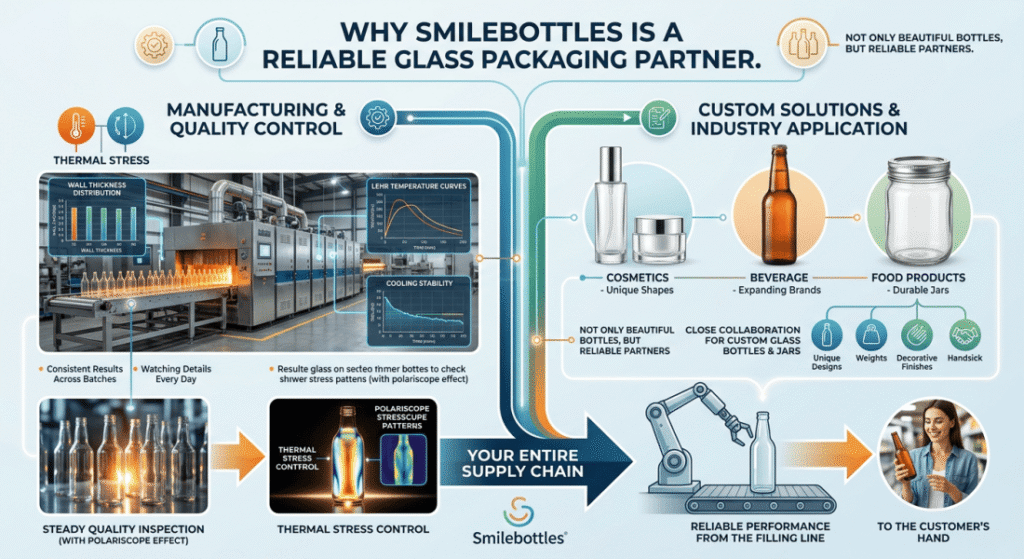
Our forming and annealing processes are set up to give consistent results across every production batch. Our team watches details like wall thickness distribution, lehr temperature curves, and cooling stability. We also work closely with customers who need custom glass bottles or custom glass jars with unique shapes, weights, or decorative finishes.
Whether you are launching a new cosmetic line, expanding a beverage brand, or looking for durable jars for food products, we combine practical production experience with steady quality inspection so your packaging performs from the filling line all the way to the customer’s hand.
Good glass packaging is not only about a beautiful bottle. It is about a bottle that stays reliable through every step of your supply chain. That is the standard we work toward.
FAQ: Frequently Asked Questions About Thermal Stress and Annealing in Glass Bottle Production
Q1:What is thermal stress in glass bottles?
A1:Thermal stress is internal stress that forms inside a glass container when different parts cool at different speeds during production. You cannot see it with your eyes, but it makes the glass weaker and more likely to crack under impact or temperature change.
Q2:Why is annealing important in glass manufacturing?
A2:Annealing removes or reduces this internal stress. Without it, even a perfectly shaped bottle can fail during filling, shipping, or storage. It is the step that turns a fragile piece of glass into a reliable container.
Can poor annealing cause glass bottles to break easily?
Yes. Bottles with residual stress may break during light impact, temperature changes, hot filling, or high-speed capping. Poor annealing is one of the most common hidden causes of unexplained breakage.
Q3:How do manufacturers test stress in glass containers?
A3:Most factories use polarized light inspection with a polariscope. Hidden stress appears as colored patterns, which makes it easy to identify problem areas and unstable batches.
Q4:Are custom glass bottles more likely to have thermal stress?
A4:Custom shapes with heavy bases, complex geometry, or uneven wall thickness are more prone to stress. That is why choosing an experienced factory is so important when you develop custom packaging.
Q5:Which industries need stricter annealing control?
A5:Hot-fill food and beverage brands, pharmaceutical companies, and premium cosmetic packaging typically require stricter annealing standards because of filling temperatures and product safety expectations.
Q6:What is the difference between annealing and tempered glass?
A6:Annealing relieves internal stress to create stable, everyday glass containers. Tempering intentionally creates surface compression to make glass much stronger, but tempered glass is not usually used for standard bottles and jars because it behaves differently under impact and cannot be easily reshaped.
Q7:Can thermal stress affect hot-fill glass bottles and jars?
A7:Absolutely. Hot fill is one of the biggest tests for annealing quality. Poor stress control almost always shows up during hot filling in the form of cracks, chips, or full breakage at the shoulder or heel.
Conclusion
Thermal stress and annealing may not be the first things you think about when you compare quotations, but they influence almost every quality issue you actually care about, including breakage rate, filling performance, shipping safety, and long-term brand reputation. When you understand these two topics, you become a smarter buyer. You know which questions to ask, what to look for during factory audits, and how to judge whether a supplier can really support your product. Whether you are sourcing standard packaging or developing something completely new, working with a manufacturer that respects the science behind the process makes a real difference.
If you are planning your next glass packaging project and want a partner that pays attention to these details, Smilebottles is always happy to talk through your design, your filling conditions, and your quality expectations, so your product reaches your customers exactly the way you imagined.
 English